
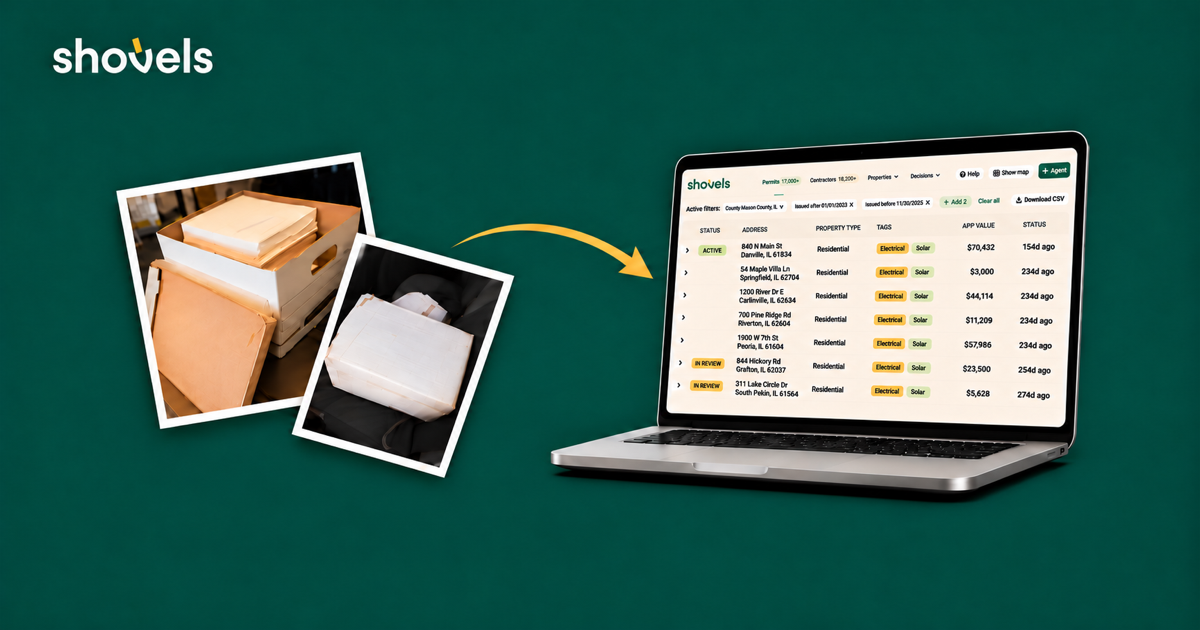

More than 10,000 jurisdictions across the United States do not have their building permits publicly available online. There's no public permit portal, no export, and no API. Instead, there's a clerk's office, a public records request, and a filing cabinet. For customers who rely on permit data to see where America is building, that's a blind spot: whole regions of construction activity simply missing from the map.
For the past year, we've been working to close that gap. The effort is called Project Storm. Its goal is simple: bring the permit data from these "offline" jurisdictions into Shovels on a reliable cadence. This way, our customers can get a complete picture of their target market based on both digitally sourced and offline data.
With our most recent release, permit data from 364 Storm jurisdictions is now live in production! See the full list of jurisdictions here.
The problem with "offline"
Offline jurisdictions range from small towns to mid-sized cities to some of the fastest-growing metros in the country. Many are rural and exurban counties where data centers, warehouses, and energy projects are breaking ground. The common factor isn't size; it's that they don’t have a public-facing digital permitting system. If you only source data from jurisdictions with a digital permitting system, you’ll miss a meaningful share of what's actually being built.
The hard part of collecting offline data isn't volume; it’s variety. No two jurisdictions handle requests the same way. Each follows its own state public records law, with its own timeline, its own accepted format, its own delivery method, and often its own fee.
One town takes a plain email. The next requires a PDF form, filled out precisely. A third only accepts requests through a public records request platform. Some want a check mailed to the clerk or building department, and a few work only on paper.
Now multiply that by thousands of jurisdictions, and remember that permit data isn't a one-time pull. To stay current, requests need to go out every month to every jurisdiction in its proper format. Every file that comes back also has to be validated and loaded into our database.
Done manually, this workload scales with every jurisdiction we add. Luckily, we can automate. This is exactly the kind of high-volume, high-variation, never-finished work that modern AI agents are built for.
Our approach: Real relationships with our jurisdiction partners, supported by a team of agents
Relationships with each jurisdiction are always at the heart of our operations. Local governments are run by people, and we take those relationships seriously. A person on our team owns every jurisdiction relationship, and that will not change.
Here’s what it looks like in practice: we introduce ourselves to the clerk or records officer. We ask how their office handles public records requests, then learn each office’s rules, formats, timelines, and fees. If a request is unclear, a person always picks up the phone.
What we automate are the repeatable tasks: the same request going out to the same office every month, the file that comes back and needs checking, the approved fee that needs to be sent out. Automation ensures a consistent request in the right format, no duplicate asks, and less back and forth.
To help us with this workload, we built a system to manage the request-and-retrieval loop. That system is a small team of AI agents, built on Claude and running on our OpenClaw framework.
Each agent is named after a WNBA team and has a clear job. The team works alongside them day to day, assigning tasks, reviewing their work, and keeping things moving in Slack:
- Valkyrie handles jurisdiction research. Point her at a town or county and she determines whether its permits are reachable online or strictly offline, tracks down the right contacts, identifies how that jurisdiction wants to be asked, and files that groundwork into our systems so a request can go out.
- Mystic handles records-request submissions across the full range of channels: government portals, public records request platforms, and web forms, each with its own logins, fields, and formats. She prepares each request for the jurisdiction's specific method. Human review and approval are mandatory before anything is submitted.
- Sparks handles intake and ingestion, the back half of the loop. She works the inbox where jurisdictions send their data back, checks that the files are what we asked for, and posts regular summaries so the team always knows what's landed and what still needs attention.
- Lynx handles file retrieval from public records request portals. When a jurisdiction fulfills a request through a portal that requires authentication, Lynx steps in: she logs in, locates the file, downloads it, validates it, and gets it where it belongs.
- Mercury handles payment. Some jurisdictions charge a fee before they can release records, and the amount, the payee, and the method differ every time. Mercury matches each fee to the request it belongs to, checks the amount against what that jurisdiction has charged us before, and prepares a check for the clerk or department that asked for it.
- Monarch is the manager agent, focused exclusively on overseeing the other agents. She evaluates each agent's work on a weekly basis and writes a report card highlighting what went well, where performance drifted, and what needs correction. Agents can also bring her questions about problems they identify in real time. She helps the fleet improve regularly, rather than waiting for someone to flag a problem downstream.
Around the agents sits a growing library of skills that handles the connective tissue: deciding which jurisdictions to pursue next based on customer demand and construction volume, managing recurring monthly requests at each jurisdiction's cadence, and routing the cases that need a person. Together, the agents and skills turn what used to be a manual, jurisdiction-by-jurisdiction grind into a repeatable, increasingly automated pipeline.
Beyond the fleet: Cyclops and the data pipeline
The OpenClaw agents handle the request-and-retrieval side of things, but what happens once the files are in? That's where Cyclops comes in.
Cyclops is an engineering-driven project focused on normalizing and standardizing the raw permit data that flows in from Storm jurisdictions, turning a heterogeneous pile of spreadsheets, CSVs, and PDFs from hundreds of different jurisdictions into the consistent, queryable dataset our customers rely on.
Together, the OpenClaw fleet and Cyclops form the full pipeline: request, retrieve, normalize, deliver.
Humans aren't going anywhere, and that's the point
The agents handle volume and consistency, and our team focuses on the work that requires relationship building and expertise: training the agents, onboarding new jurisdictions, expanding into new data types, and nurturing partnerships that turn a one-time request into a reliable, recurring data channel.
Dealing with complexity is how our agents get better. Every edge case a person handles becomes a signal that lets an agent take a little more off the team's plate next time. The combination compounds: the agents scale the repeatable volume while our team's institutional knowledge, jurisdiction relationships, and judgment deepen the moat around the whole operation.
Next year, we want to give more back. Alongside deepening those relationships, we’re building dashboards and maps that help each jurisdiction understand its own permitting trends and see activity in surrounding jurisdictions, so the exchange runs in both directions.
If you work for a jurisdiction and want to see what your own permitting data can tell you, we’d love to hear from you. Get in touch with us directly.
This release is just the beginning
Many permit-data companies stop at online portals. We didn't. And our approach is working. Since launching Project Storm, we've connected with about 1,000 offline jurisdictions and turned coverage gaps into reliable data channels.
With our recent release, the first group of jurisdictions is live in production, their permits flowing into Shovels exactly like data from any online source. Stay tuned as each new data release brings more Storm jurisdictions into the pipeline!
Frequently Asked Questions
- How does Shovels collect permits from offline jurisdictions?
-
We send public records requests to each jurisdiction's clerk or building department. Each request follows that office's own rules, format, timeline, and fees, whether that's an email, a PDF form, a records request platform, or a mailed check. Every file that comes back is validated and loaded into the Shovels database.
- What do AI agents do in Project Storm?
-
A team of AI agents, built on Claude and running on our OpenClaw framework, handles the repeatable parts of the request-and-retrieval loop. They research jurisdictions, prepare records requests, retrieve and check returned files, and prepare fee payments, while a manager agent reviews their work. A person reviews and approves every request before it's submitted.
- Do people still manage the relationships with jurisdictions?
-
Yes. A person on our team owns every jurisdiction relationship. They introduce Shovels to the clerk or records officer, learn how that office handles requests, and pick up the phone when a request is unclear. The agents take on the volume so the team can focus on onboarding new jurisdictions and building partnerships.
- How often does Shovels request new records from offline jurisdictions?
-
Permit data isn't a one-time pull. We request new records from most jurisdictions every month, though the schedule varies by jurisdiction. Each recurring request goes out in that jurisdiction's required format.
- How does offline permit data become usable in Shovels?
-
Our engineering team normalizes the spreadsheets, CSVs, and PDFs that jurisdictions send back into one consistent, queryable dataset. Offline permits use the same schema as every other permit in Shovels and are available in Shovels Online, the API, the CLI, and bulk data.
Want to make sure your coverage areas are included? Project Storm prioritizes jurisdictions based on customer demand. If you need data from specific offline jurisdictions, let us know.