
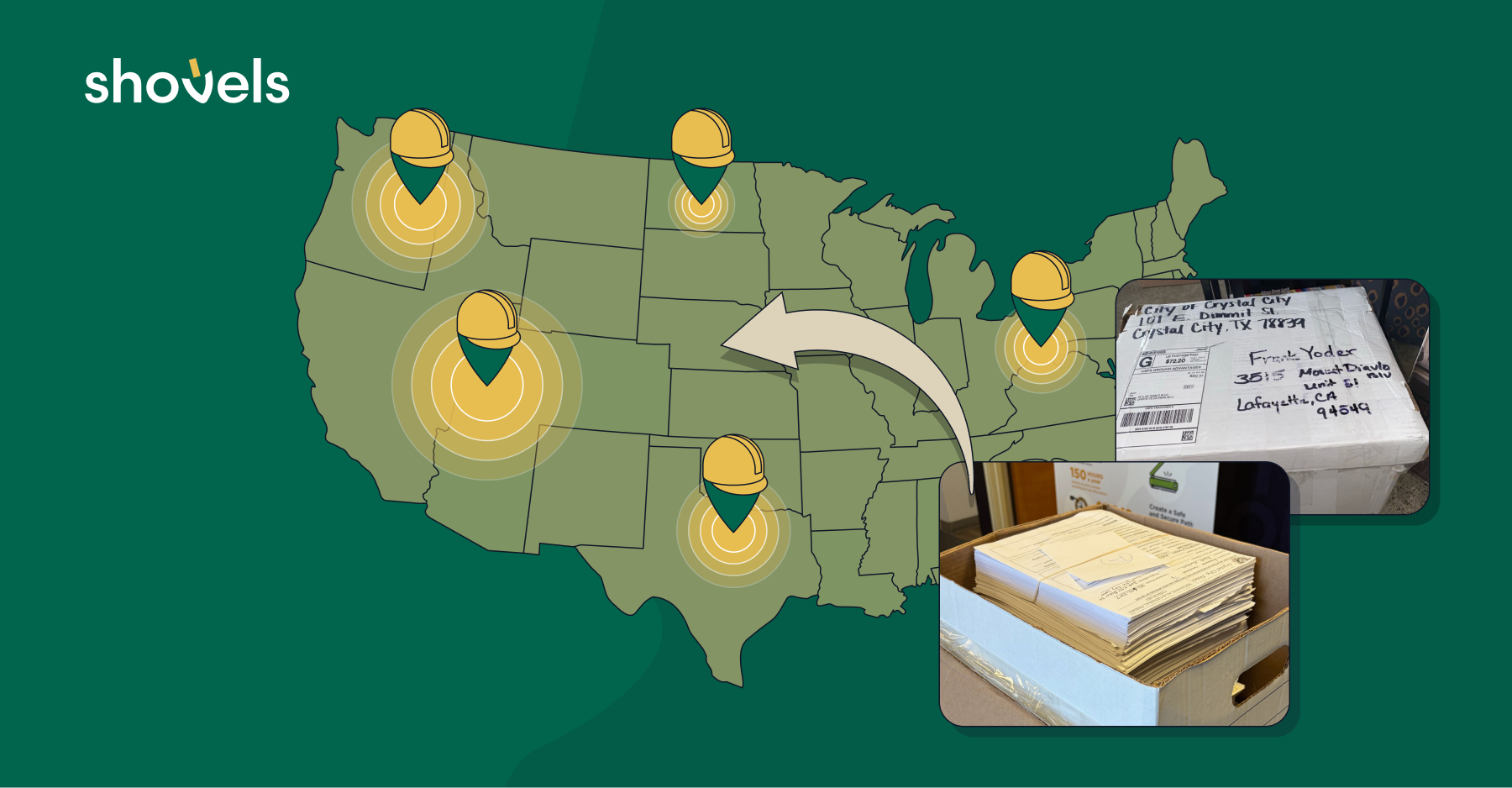

Thousands of U.S. jurisdictions issue building permits without making them searchable online. Often, there are no public permit portals, data exports, or APIs to pull from. In many cases, the records have to be requested from the clerk or building department, by email or through an online records request portal.
As of our November 15th data release, Shovels includes 364 of these “offline” jurisdictions. You can now search for their permit records using Shovels Online or access them through the Shovels API, CLI, and enterprise bulk data shares.
Our offline coverage now includes:
- 364 jurisdictions in 38 states, from rural counties to cities of more than 100,000 residents
- Nearly 1.5 million permits, mostly issued in 2025 and 2026, with some records dating to 2000
- New records requested monthly from most jurisdictions
Why “offline” coverage matters
Datasets built only from online sources have predictable blind spots, and they aren’t limited to small towns. Our offline coverage includes rural counties with major industrial development, exurbs on the edges of large metros, and established suburbs with tens of thousands of residents.
Our recently added jurisdictions, for example, include 70+ data center sites and over 1 million residential permits.
Leaving these places out means dramatically undercounting the market. This expanded coverage gives our customers a more complete view of building activity across entire regions, supporting better research and planning:
- Building materials and distribution teams can measure construction demand across whole regions.
- Site selection and industrial teams can track activity in rural and exurban areas where large projects are taking shape.
- Telecom, energy, and infrastructure teams can follow buildouts across growing counties.
- Researchers, investors, and policymakers can study housing supply, affordability, and development patterns with fewer gaps.
What our new coverage includes
Our offline coverage spans 38 states and four main regions in the Midwest, Northeast, South, and West. Below is a complete table of the jurisdictions now covered:
| State | Jurisdictions |
|---|---|
| Arizona | Yuma County |
| California | Baldwin Park, Blue Lake, Brawley, Calexico, Cerritos, Coachella, Colma, Dana Point, Del Rey Oaks, Dixon, Dorris, El Centro, Emeryville, Encinitas, Fillmore, Fountain Valley, Fresno, Fresno County, Huntington Park, Lakewood, Livingston, Loomis, Mammoth Lakes, Maricopa, McFarland, Monrovia, Monterey, National City, Norco, Oakdale, Oakley, Paradise, Patterson, Plymouth, Pomona, Rio Dell, Ripon, San Juan Bautista, Santa Paula, Sierra County, Suisun City, Taft, Tulare, Tulelake, Turlock, Union City, Watsonville, Wildomar, Willows, Woodlake, Yucca Valley |
| Colorado | Garfield County, Morgan County, Otero County, Windsor |
| Connecticut | Ledyard, Norwalk, Waterbury |
| Florida | Baldwin, Calhoun County, Callahan, Clewiston, Glen Ridge, Hialeah Gardens, Indian Harbour Beach, Lake Butler, Minneola, Neptune Beach, Oakland Park, Ocoee, South Daytona, Union County, Valparaiso |
| Georgia | Bartow County, Chattahoochee Hills, College Park, Columbia County, Jefferson, Kingsland, Loganville, Long County, Palmetto, Roswell, Stephens County, Stockbridge, Warner Robins, White |
| Idaho | Ammon, Idaho Falls |
| Illinois | Belleville, Bloomingdale, Bond County, Champaign County, Cicero, Clinton, Collinsville, Cook County, Dolton, East St. Louis, Effingham, Forest View, Golf, Hanover, Harvard, Jersey County, La Grange, Lansing, Markham, Mascoutah, Massac County, Mattoon, McLean County, Midlothian, Moline, Monroe County, O'Fallon, Oak Forest, Olney, Oswego, Paris, Randolph County, Richton Park, South Holland, Springfield, Sterling, Stickney, Summit, Tazewell County, Tolono, Vernon Hills, Washington, Waterloo, Winnebago County, Winnetka |
| Indiana | Crawfordsville, Decatur, Hobart, Huntington County, New Castle, Speedway, St. John, St. Joseph County, Vigo County, West Lafayette, Westfield, Yorktown |
| Iowa | Allison, Butler County, Cass County, Floyd County, Fort Madison, Jasper County, Knoxville, Newton, Walnut |
| Louisiana | New Orleans, Sulphur |
| Maine | Lewiston, Sanford, Scarborough, Waterville |
| Maryland | Kent County, La Plata |
| Massachusetts | Carver, Chicopee, Fairhaven, Hingham, Holyoke, Hopkinton, Hull, Ipswich, Middleborough, North Adams, Spencer, Whitman, Wilbraham, Wilmington, Wrentham |
| Michigan | Bay City, Oshtemo Township, Taylor, Tuscola County |
| Minnesota | Big Lake, Brown County, Clay County, Cloquet, Columbia Heights, Cottonwood County, Ham Lake, Lyon County, Monticello, North Branch, Otsego, Winona, Worthington |
| Mississippi | Flora, Meridian, Ocean Springs |
| Missouri | Montgomery County, Platte County, Warren County |
| Montana | Havre |
| Nebraska | Lexington |
| Nevada | Boulder City, Humboldt County, Lincoln County, Mineral County, Storey County, Winnemucca |
| New Hampshire | Nashua, Windham |
| New Jersey | Camden, Freehold Township, Glassboro, Lawrence Township, Long Branch, Millville, Monroe Township, Neptune City, Paterson, Upper Township, Winslow Township |
| New York | Amsterdam, Arcadia, Beacon, Carmel, Grand Island, Malta, Newark, Patchogue, Rome, Schenectady, Webster, Whitestown |
| North Carolina | Bladen County, Caldwell County, Cleveland County, Craven County, Duplin County, Greensboro, Halifax County, New Bern, Pamlico County, Rocky Mount |
| Ohio | Beachwood, Brunswick, Chillicothe, Dayton, Defiance, Dover, Englewood, Fairfield County, Huron County, Lucas County, Mahoning County, Massillon, Miamisburg, Monroe, North Ridgeville, Portsmouth, Reynoldsburg, Springboro, Stark County, Summit County, Wayne County |
| Oklahoma | Del City, Harrah, Mustang, Oklahoma County |
| Oregon | Hillsboro |
| Pennsylvania | Baldwin Borough, Bethel Township, Caln Township, Carlisle, Chestnuthill Township, Columbia Borough, East Pennsboro Township, Emmaus, Freeland, Manor Borough, Meadville, Newberry Township, North Whitehall Township, Palmer Township, Penn Hills, Radnor Township, Rapho Township, Ridley Township, Spring Garden Township, Warrington Township, West Hempfield Township, White Township, Yardley |
| Tennessee | Hamilton County |
| Texas | Balch Springs, Brazoria, Brownwood, Corpus Christi, Eagle Pass, Edgecliff Village, Forest Hill, Garland, Glenn Heights, Hidalgo County, Highland Park, Huntsville, Jefferson County, Kaufman County, Lake Dallas, Mason, Midland, Montgomery, Montgomery County, Oak Point, Oak Ridge North, Palmview, Pasadena, Pearland, Richland Hills, Rockport, San Juan, University Park, Walker County |
| Utah | Carbon County, Centerville, Highland, Hooper, Midvale, Washington County, West Point |
| Vermont | Brattleboro |
| Virginia | Franklin County, Montgomery County, Portsmouth, Stafford County |
| Washington | East Wenatchee, Harrah, Pend Oreille County, Renton, Snohomish County, Snoqualmie, West Richland |
| West Virginia | Beckley, South Charleston |
| Wisconsin | Beaver Dam, Beloit, Brookfield, Harrison, Lisbon, Little Chute, Manitowoc, Mequon, New Berlin, River Falls, Rusk County, Sawyer County, Sheboygan, South Milwaukee, Stevens Point, Waupun, Whitefish Bay |
| Wyoming | Campbell County, Sweetwater County |
For our full coverage by state, metro area, county, and jurisdiction, see the Shovels coverage dashboard.
What's included in the data
Same schema. Permits from offline jurisdictions use the same schema as the rest of Shovels’ permit data, so they work with your existing searches, exports, and integrations.
Our core fields. Most permits include a permit number, address, status, and description. In some jurisdictions, the address is partial or the status is not reported.
Additional details. Where available, records also include permit type, valuation, contractor, and parcel details. Field completeness varies by jurisdiction.
Monthly updates, for the most part. We request new records from most jurisdictions monthly. Records typically arrive about a month after they’re issued.
How we collect offline data
This release is the first major milestone of the Project Storm team, which we introduced last year. Public records processes can be complex, so we follow the same five steps for each jurisdiction to ensure we provide clean, standardized data that’s ready to use.
1. Prioritize. We rank jurisdictions by customer demand, construction volume, and recent construction activity, so the places you need to see come first.
2. Research. We confirm that a jurisdiction’s permits aren’t already available online. If they are, we collect them through our online pipeline. For the rest, we identify the right records contact and learn how that office handles records requests, which varies by jurisdiction as well as by state law.
3. Set up a recurring request. A member of our team contacts each records office to agree on how records will be sent and whether there’s a fee. Depending on the office, requests may go by email, PDF form, records portal, or fax. Some jurisdictions add us to a recurring distribution list. Most send new records monthly. We treat each jurisdiction as a long-term partner, not a one-time source.
4. Receive and review. Records arrive by email or are posted to a records portal for us to retrieve. We check each delivery against what we requested and follow up if anything is missing.
5. Standardize and check. Engineers map each jurisdiction’s records to the Shovels schema and run quality checks on every delivery before it’s published.
AI agents handle much of the research, recurring requests, and file intake, including checking that each delivery is complete, while our team sets up each jurisdiction relationship, approves where and how requests are sent, and signs off on every fee payment.
To date, the team has built working relationships with nearly 1,000 jurisdictions that now provide permit records on a recurring basis. The 364 now in Shovels have completed processing and quality checks. More jurisdictions will be added in future releases as we bring in additional record formats.
Some building permit records are still on paper. Here’s an example.
“There’s no shortcut to this work. Every jurisdiction has its own rules, so we build a working relationship with each one. That steady, local work turns blind spots into data our customers can use.”
Ryan Buckley, CEO and co-founder of Shovels
How to request a jurisdiction
We prioritize jurisdictions based on customer demand. If your markets include an offline jurisdiction we don't cover yet, let us know.
How to get access
The new data is available today in Shovels Online, the Shovels API, the Shovels CLI, and, for enterprise customers, bulk data deliveries. There's nothing to turn on: permits from these jurisdictions appear in the same searches, exports, and API responses as the rest of your Shovels data.
Not yet a customer? Explore Shovels data for free, or contact us to talk through your use case.
Frequently Asked Questions
- What is an offline jurisdiction?
-
A city, county, or town that issues building permits but doesn’t make them searchable through a public permit search, data export, or API. Its records are available by request.
- How many offline permits and jurisdictions does Shovels cover?
-
Nearly 1.5 million permits from 364 jurisdictions in 38 states.
- How far back does the data go?
-
Most permits were issued in 2025 and 2026. Some jurisdictions provided records dating back to 2000.
- How often is the data updated?
-
We request new records from most jurisdictions monthly. Records typically arrive about a month after they’re issued.
- How do I see which areas are covered?
-
The Shovels coverage dashboard shows coverage by state, metro area, county, and jurisdiction.
- Do I need to change my integration?
-
No. The data uses the same schema and delivery channels as the rest of Shovels’ permit data.