Track rezonings and development pipelines across multiple jurisdictions. Spot pockets of growth and identify emerging markets before they show up in listings.








Shovels is SOC 2® Type II certified
We meet the security and compliance requirements of enterprise real estate firms and proptech platforms. Property data, permit records, and market intelligence are protected by independently audited controls built to hold up to enterprise security reviews.
01
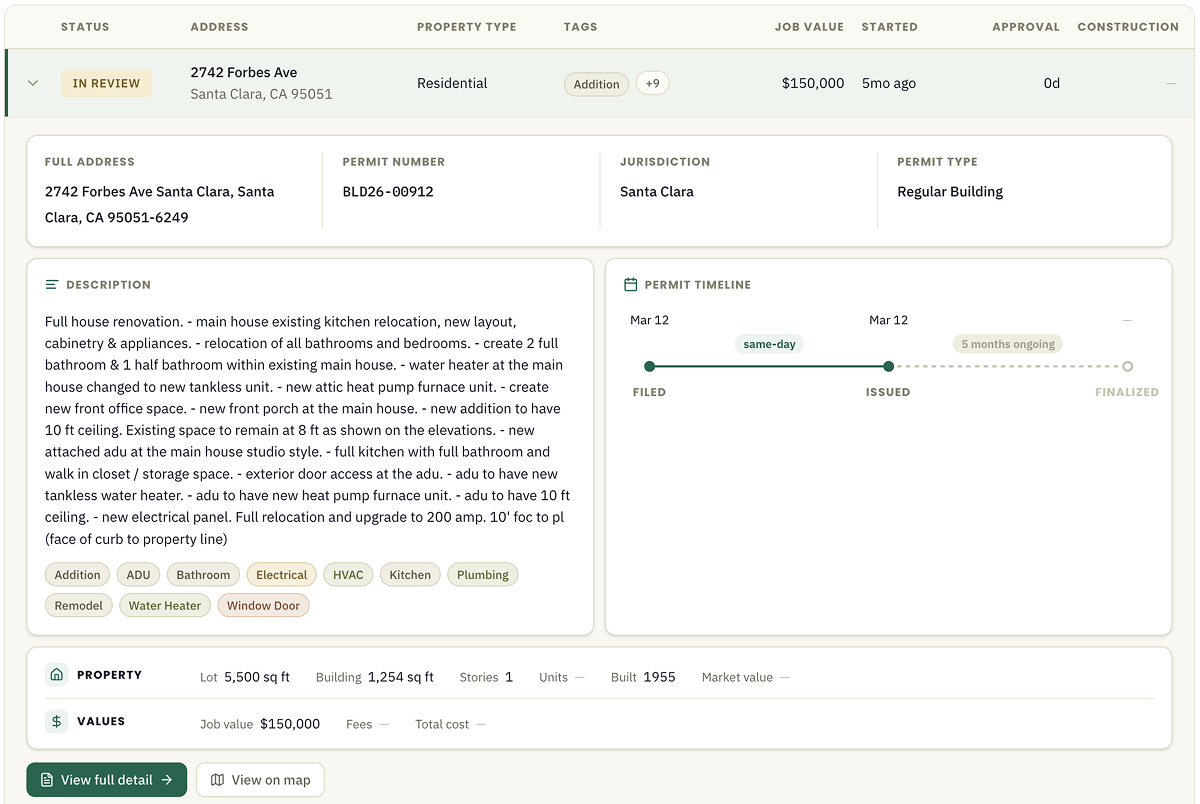
See every remodel, addition, and repair on the property. Know exactly what was permitted and built.
02
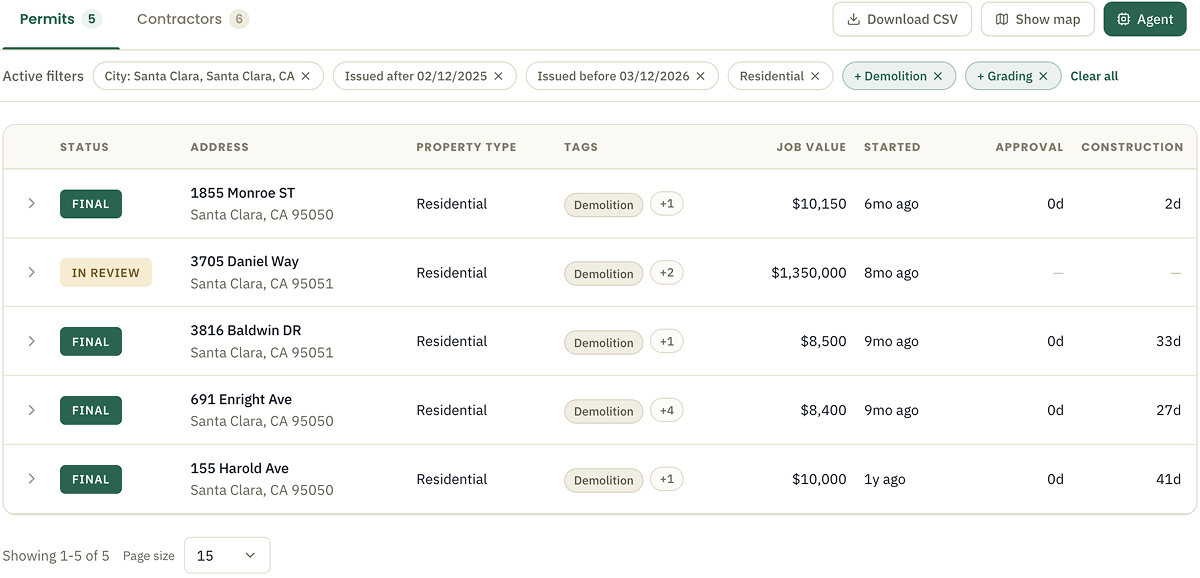
Grading and demolition permits signal early-stage construction months before a project appears on MLS or CoStar. Follow individual developments from start to finish.
03
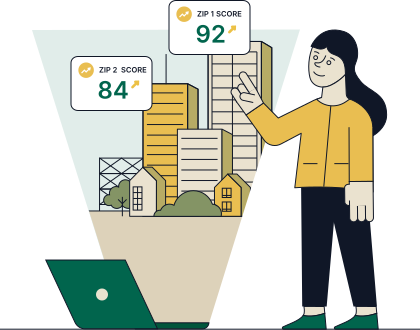
Instead of validating a site after you find it, work backwards. Use permit and Decisions data to identify up-and-coming neighborhoods and target acquisitions there.
04
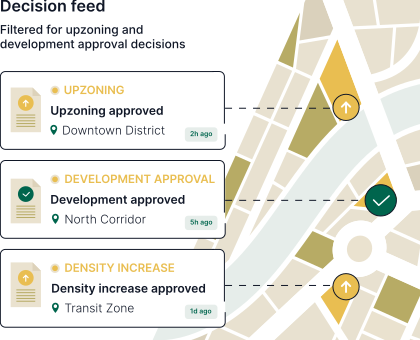
Shovels Decisions offers access to city council decisions on upzoning, development approvals, and housing mandates, so you can see where permit density will rise before land values move.
05
Property data analytics tools typically depend on closed transactions and listing history. Shovels gives you real-time construction activity from permit filings.


Access our data via API, SFTP, Snowflake, BigQuery, or Databricks. Custom feeds are also available.

Clean, structured inputs out of the box. No raw text parsing required. Check out our data dictionary for details.

Millions of new records (online and offline sources) are added each cycle to keep your data fresh.
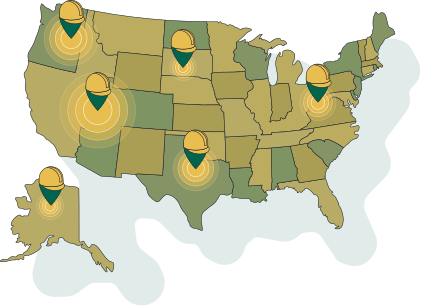
We source data from thousands of jurisdictions online and offline through public records. New jurisdictions are added continuously based on market trends & customer demand, with coverage spanning all major metros and expanding rural markets.
Yes. A Neighborhood Vitality Index is any permit-based score that measures improvement activity in an area. Shovels gives you the inputs: home improvement permits classified by work type, aggregated to parcel, census tract, or ZIP code, so you can compute and weight the index however your team defines vitality.
Shovels Decisions aggregates zoning changes, conditional use permits, upzoning discussions, and development approvals from city council meetings nationwide into a single searchable database.
Yes. Shovels integrates with Esri and Regrid for GIS-based workflows, including parcel boundary and ownership data. Deliver via property data API or Snowflake, BigQuery, or Databricks.
Permit records are updated twice monthly, with millions of new records added each cycle. Decisions data is updated continuously as city council meetings are processed.
Shovels lets investors and analysts apply a predictive analytics approach to real estate by tracking permit activity as a leading indicator of neighborhood change. Rising permit volume in a ZIP code — especially for ADUs, renovations, or multi-family conversions — often precedes price appreciation by 6–18 months. Shovels surfaces these signals so you can move before the market catches up, whether for investment decisions or commercial real estate lead generation.
Shovels enables a permit-first market data approach in real estate: instead of analyzing closed sales or price trends (lagging data), users spot up-and-coming neighborhoods from permit filings the moment they're recorded. This gives investors, developers, and data platforms a months-long head start on where capital is flowing and which neighborhoods are on the move.
See how Shovels gives real estate teams the permit and Decisions intelligence to move earlier than the market.