
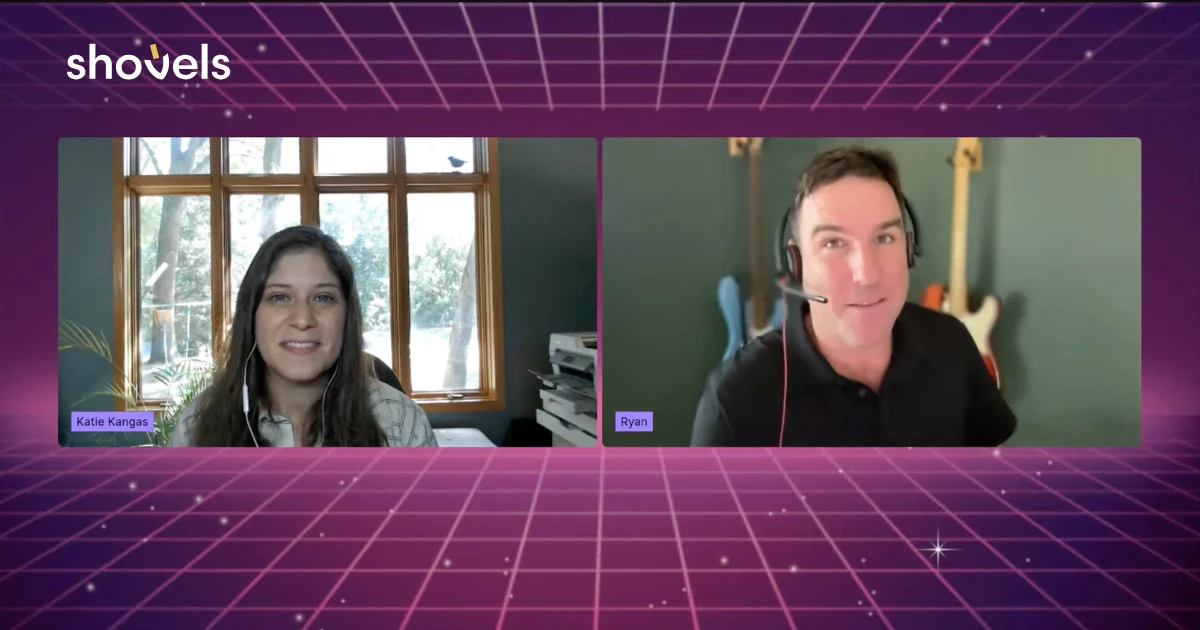

Shovels co-founder and CEO Ryan Buckley joined Katie Kangas for "Flying Solo with Katie Kangas," a segment of DATM 2026, Gabl Media's all-day online stream. Their conversation covered building permits, government data, AI agents, and why human taste matters more than ever. They talked about how developers use permit data for site selection, why "ground truth" beats AI guesses, how Shovels serves both small firms and large enterprises, and where data centers fit into all of it.
Watch the full conversation on YouTube
The transcript below has been lightly edited for clarity and length.
Katie Kangas: Welcome, Ryan. You co-founded Shovels to use AI to tackle permitting and data management on construction projects, which keeps getting harder to track with all the trades and everything going on. I see this in my own practice. Thank you for joining us.
Ryan Buckley: Thanks. Glad to be here.
Katie Kangas: In your own words, what problem are you solving with Shovels?
Ryan Buckley: We believe you can't manage what you don't measure. There are a lot of important policy questions coming up right now around data centers and affordable housing.
When I first started Shovels, I was most interested in energy, specifically residential renewable energy adoption. Are we going to install enough heat pumps to meet our energy targets? Do we have the labor force to do it? How many homes, how many heat pumps, and how long will it take?
It was clear to me that to figure this out, we'd need to look at all of the building permits, track them, and understand who's doing the installing. The challenge of doing that is ultimately what led to Shovels.
Katie Kangas: That's so much information. I used to think of permits as just the one you apply for yourself. But when you're tracking everyone's applications, you're almost getting a live feed of the decisions being made, and of the mindset of the people reviewing new applications.
Ryan Buckley: That's right. And for the last year or so, we've been expanding Shovels from purely building permits to everything governments are thinking about, discussing, and approving. That means parcels, properties, and decisions in meeting agendas, minutes, and transcripts. We cover everything from really small towns to cities and counties, and we just started tracking municipal utility districts.
Katie Kangas: That's incredible. I've been through historic preservation commission meeting minutes trying to track what's been happening, and it's hard to do. I already see the value in being able to process and manage that. What other ways do you see this integrating into architecture and construction practices as a tool professionals can lean on?
Ryan Buckley: I'll start with the construction side. We see it through the eyes of developers in a couple of ways.
The first is site selection: understanding where to start looking at acquiring land or working with landowners to redevelop. What's the history of that parcel? If you already have an idea of what you want to build, what has the community's opposition historically looked like? What has city council said about it? Then you look at the surrounding parcels. How long does it take to get a large permit approved, and what does construction time typically look like?
That timing question is really important. Say you're somewhat flexible. You have a quarter-mile or half-mile radius around a particular spot, and any number of parcels in that radius would work. But a jurisdiction line happens to cut through it, and jurisdiction A and jurisdiction B have very different approval processes. It's clear in the data that one approves much faster than the other. The only way to tease that out is to collect all of the permits, clean and sift through them, and then run statistics on them. Time is money, and all else equal, you want to go with the jurisdiction that approves faster.
The second use case comes from working with residential developers. Forecasting supply and demand as accurately as you can is critical so the rents pencil out. We can sometimes see in the building permits, or even in meeting transcripts, that a competing development a little further along is going to add supply in the same area. That means the rents you expected to collect may not be as feasible. Our data can provide that insight so you don't get too far along and then get surprised.
Katie Kangas: I love that. Researching all of this is a ton of work, with so many people to talk to. How are professionals leaning on your AI platform? Are they duplicating the work to audit it? How do they come to trust it, given the fear that AI hallucinates?
Ryan Buckley: This is a little self-serving, but there's also something interesting we're seeing in how companies are behaving.
Ground truth is super important. You don't want to ask an AI like Claude, ChatGPT, or Gemini for the permit history of a parcel. Who developed it? How many permits? What's the total job value put into it? When was the last grading or demolition permit in the area? There's no way for those models to know that from their training.
The AI companies are helping their models recognize when they don't know something, so instead of hallucinating, they go do web research. That's all new in the last year or so. But many of these data are behind authentication walls or aren't online at all. A lot of the work we do is public records requests.
So when we tell our clients that this isn't token-generated synthetic data, that it's ground truth, and that everything we deliver is sourced back to the jurisdiction, they can and should trust that it's correct, because we stand by it.
The other thing we're seeing more of is that companies are building their own interfaces. They're having AI tools create the perfect, bespoke workflow for their specific use case, and you now have teams building their own software inside architecture and construction companies.
Here's the self-serving part: for that software to work, it needs a data source. It needs ground truth. We're building our platform to be extremely agent-friendly. The way we see it, one or two years from now, maybe sooner, every department and definitely every company is going to have a team of research agents at its disposal. This is like OpenClaw. We just had Grok Bot put out by xAI, and Meta is coming out with its own set of personal bots.
We think bots are going to get the equivalent of credit cards and budgets. You'll ask for a research project on a parcel, and the bot will come back and say, "I found a great source, but it's going to cost $562. Can I get approval?" Eventually that transaction will be autonomous. You'll give the bot $50 and say, "Go to all the different sources, compile it, give me the report, and spend this the best way you see fit." We're building our platform to be that ground truth for anything governments are thinking about or approving.
Katie Kangas: So what's the human element? As technology transforms the built environment, what's one principle, practice, or human value the industry must protect? You have people collecting data and procuring records right now, and you see a future where you're almost putting yourself out of a job. What remains human?
Ryan Buckley: This is critical, and it's why even companies like ours, which are trying to live in the future, are still hiring humans. We've been on a hiring binge. If I can put it in one word, it's taste.
The bots and agents don't really have taste. You saw it first with writing on LinkedIn. It's very clear who just asked an AI to write their post. People say there's a smell to AI writing.
We had a neighbor over for dinner last night who's an elementary school teacher. She said it's so clear when her students' parents write emails to her using ChatGPT. It drives her nuts because they all look and sound the same. They use the same vocabulary and ask the same things in the same order. It feels impersonal and bland.
That's what I mean by taste. We're moving into an era where everybody's building sophisticated apps and entire websites, and it's obvious when someone has vibe-coded something just by chatting with an AI. The result has no taste. If you let the agent run on autopilot, these apps are all going to look the same and do the same thing in the same way.
It's the human element that creates taste, and taste creates differentiation: a special, unique way of looking at a combination of data. You still work with agents, but you demand that they do things a certain way. Instead of them driving you, you're driving them, and that instills your taste into the final output. Everybody else will converge on tasteless, average, boring output. The companies that succeed in an AI-driven future are the ones where humans drive the agents, not the other way around.
Katie Kangas: We see that craving for taste immediately when you get put on a phone call with a chatbot. There are a lot of "let me talk to a human" requests.
At the beginning, you talked about records of government decisions. Government may eventually have bots, but that'll probably take longer. Right now, planning commissions are driven by personnel who turn over every year, with different personalities and personal experiences. Developer presentations are sometimes received differently depending on how they're presented and whether the commission likes them. You're sometimes asking for variances, breaking the rules in mindful ways that benefit the community, and there's a human element to that. We don't have bots talking to bots yet, so how do you use your technology to navigate the human side of the regulatory process?
Ryan Buckley: It's a really interesting question, and one we're just starting to explore as we collect meeting documents, transcripts, agendas, and minutes from all sorts of government bodies, including planning commissions, county supervisor meetings, and city councils.
Here are my thoughts, and I'm borrowing a framework from Andrej Karpathy, one of the AI thought leaders. Going back to the 1900s, think about space travel and the internet. Those were massive government-driven innovation projects that later trickled down to consumers. The internet is the biggest example.
AI is moving in the completely opposite direction. There was no government AI project like that. It came from the ground up. I believe it was a Google team that wrote the initial paper the ChatGPT team ran with.
What that means is government is going to remain pretty late on the adoption curve, and we see that in our own experience. When we go after public records requests, we do it manually. The initial touch is a Shovels human reaching out to a building department human and doing human things: talking on the phone, emailing, introducing ourselves. Increasingly, we hear from those building departments, "Oh, you're not a bot. It's so refreshing that you're a real person asking for this. Of course I'd be happy to help you get these building permits." We have more automation after that.
The lesson is that because government is slower to adopt and will likely remain human-driven for years, you have to keep that in mind. And to tie it back to taste, that's a way to differentiate right now. A lot of companies are trying to take shortcuts through bots and agents. But bringing a warm apple pie into the building permit office, leaving it on the counter, and asking, "Hey, how's my application going?" Doing things the old-fashioned way is, maybe ironically, a little more effective now, because people miss it.
Katie Kangas: I sense that craving for the nuance of human conversation and connection too. Especially in the small towns I work with, where the building department is probably closed on Fridays, if not by 11 a.m., because everyone goes hunting or fishing for the weekend. You get to know them.
With the Flying Solo podcast, I specifically encourage small and solo firms, and I feel like Shovels could be a full research department in the pocket of a small firm. Do you see that potential? Some technology companies only want to cater to big companies because it's less work. What's your philosophy on serving small firms versus large ones?
Ryan Buckley: We're doing both.
This is Silicon Valley speak, but I'll bring that perspective since we're a venture-backed startup there. Forgive the acronyms: PLG and SLG, product-led growth and sales-led growth.
PLG tends to be self-serve with a lower price point. You don't sit through a demo or sign a contract, and you can cancel anytime on your own without calling in. SLG is typical enterprise sales: you do a demo, bring in the buying committee, and eventually sign a 12-month contract with no backing out.
Traditionally, startups and small tech companies picked one or the other. Because of AI, companies can now do a hybrid, and we've used the hybrid model from the beginning. On the self-serve side, you can put in a credit card and get full access to our data, our API, and our web application, and if you write in, a human writes you back. We love helping small businesses. Going back to my introduction, I originally had climate tech startups in mind: heat pump HVAC installers and the software around them, EV chargers, solar panels, demand response software.
We also continue to sell our data on the enterprise side, to publicly traded building product manufacturers, telecoms, hyperscalers, and very large residential and commercial builders. Those are big, chunky datasets we send to their data warehouses, working with their data engineering teams.
Katie Kangas: That's fascinating. I'm going to put you on the spot for a hot take on data centers, because there's some contention about them in the industry. What are your thoughts?
Ryan Buckley: That's a big one. I can answer objectively from what we see in the data, which is a lot of opposition. But, as the bulls would say, there's also a lot of demand for data centers. This stream is being run on a data center. Everybody loves these new AI tools that use a ton of compute, but no one wants them built nearby. It's a sort of NIMBYism, along with what I think is some unfounded fear about the environmental impacts. I'm not the expert on exactly what those impacts are, and time will tell.
What I do believe is that what gets us over this hump is permit reform, energy production, and high-voltage transmission lines. This has been an ongoing problem. There's a great book, Superpower by Russell Gold, about Michael Skelly, who tried very hard to develop the country's first ultra-high-voltage transmission lines. He wasn't successful. Had he been, I think a lot of these data center fears would be moot.
Our grid has been underinvested in and ignored for decades. This was a known problem that was going to come back and bite us, and now it's biting us, suddenly but not unexpectedly.
In an ideal world, we fix both at the same time: build the data centers and fast-track a bunch of ultra-high-voltage transmission lines to carry power from solar and wind farms in the middle of the country to where the data centers are, closer to where the bulk of the country wants to use them.
Katie Kangas: The funny thing is the problem has been in the data the whole time, and people were ignoring it. It goes back to "you can't manage what you don't measure." That feedback loop could eventually lead to new permitting processes or building codes, and maybe that will start to untangle the decision process we're in the middle of. Thank you for that hot take. I know it's a divisive issue.
Any last words you'd like to leave folks with about technology and the future?
Ryan Buckley: Be very aware of what's happening with AI, and don't be afraid to use it. I want to go back to the idea of taste. The companies that leverage their own taste the most, and the people inside them, the architects, builders, and entrepreneurs who drive the AI instead of letting the AI drive them, are going to do extremely well. That's the thing to keep in mind as we go through this "what a time to be alive" moment. It's really exciting.
My optimistic take is that all of this technology, and what AI will enable us to build, will actually help us solve the environmental challenges that got me into this space in the first place. It'll probably take a whole bunch of data centers getting built to solve the problems we need to solve. So that's really it: taste and optimism.
Katie Kangas: I love that invitation to be more human and bring that into our practice, because that's the magic element. Thank you so much, Ryan. I definitely want people to check out Shovels, especially as you keep growing and developing. Very fun stuff.
Want to see what ground-truth permit data can do for your projects? Contact Us.