


The data center buildout continues to expand. But municipal resistance is also growing, and counties want to set the terms before new projects arrive in their area.
According to Shovels data, project filings in the first seven months of 2026 ran 29% ahead of the same period last year, while the industry’s footprint expanded from 13 states to 19. Yet local governments are responding even faster. Within a fixed panel of jurisdictions covered consistently in 2025 and 2026, data center matters rose from 0.11% to 0.30% of all local decisions. Moratorium activity jumped from roughly 1% of those decisions to 28%.
In June, we found that the fastest-approving markets are generally those that had settled their zoning and utility questions years before a building permit was filed. The latest data shows us the other side: communities across the country that are now rushing to settle pressing questions before the next wave of development reaches them. The moratoriums making headlines are not the whole story. Most are short-term halts that will give way to frameworks governing every application that follows.
Key takeaways
- Policy is outpacing construction. Data center decisions rose 2.6 times as a share of all local decisions in a fixed panel of 285 jurisdictions, while projects rose 29% year over year.
- Moratoriums went from rare to routine. Moratorium activity rose from roughly 1% of data center decisions in early 2025 to 28% in 2026, with 313 measures reaching local governments across 138 jurisdictions.
- Moratoriums generally follow a similar pattern: pause and rewrite the code. 290 of 341 moratorium records (85%) are filed as zoning code modifications, and 43% of all code modifications carry moratorium language.
- Michigan is heavily restricted with almost nothing built: Trackers count dozens of local moratoriums and bans there, against two operating data centers statewide and a single data center project since 2022, permitted in July 2026.
- The permit clock is not the clock in the headlines. The six-to-eighteen-month figure commonly quoted describes entitlement, not the building permit. Loudoun County's data center building permits have run annual medians between 29 and 112 days since 2022.
Methodology: how we measured the buildout and the response
This analysis pairs two Shovels datasets. The project sample covers 295 active data center projects permitted between January 2022 and July 2026. Each record in Shovels' new construction data center classification counts as one project, except where a single campus filed several permits carrying no street address. Those are counted once.
The municipal sample covers 1,422 zoning votes, planning commission rulings, moratoriums, code amendments, and other land use actions filed between January 2022 and August 2026 across 45 states from Shovels Decisions.
We identified data center matters through title and description text, and moratorium matters through moratorium language within that set. Year-over-year decisions comparisons therefore use a fixed panel of 285 jurisdictions with consistent coverage between both January–July 2025 and January–July 2026.
Together, the datasets show directional trends across a large share of the US market, not a comprehensive census of national data center activity.
The buildout kept expanding in 2026 and reached six more states
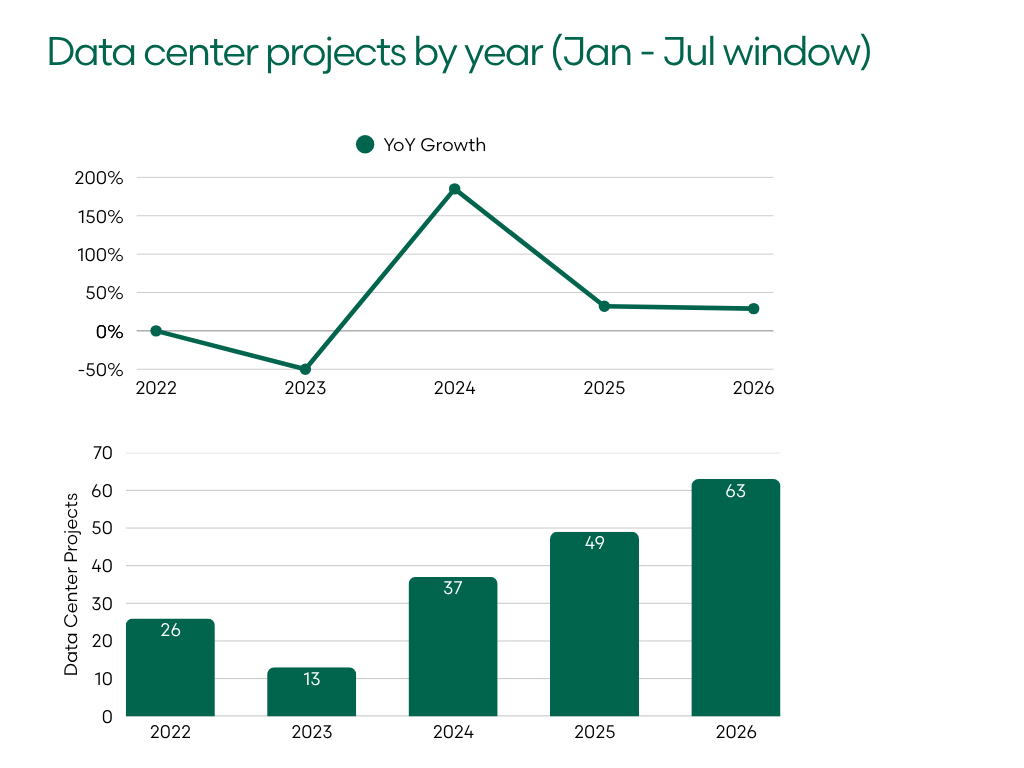
First, data center construction shows no sign of slowing down. Across comparable January-through-July windows, data center permit filings have risen every year since the 2023 trough and kept expanding in 2026.
| Jan-Jul window | Projects | States | Project YoY |
|---|---|---|---|
| 2022 | 26 | 9 | - |
| 2023 | 13 | 6 | -50% |
| 2024 | 37 | 13 | +185% |
| 2025 | 49 | 13 | +32% |
| 2026 | 63 | 19 | +29% |
The sixty-three projects tracked in 2026 represent the highest volume in any year of the dataset. The jump from 13 states to 19 also marks the widest single-year geographical expansion we have recorded. Whatever effect local resistance may eventually have, it has yet to show up as a slowdown in filings.
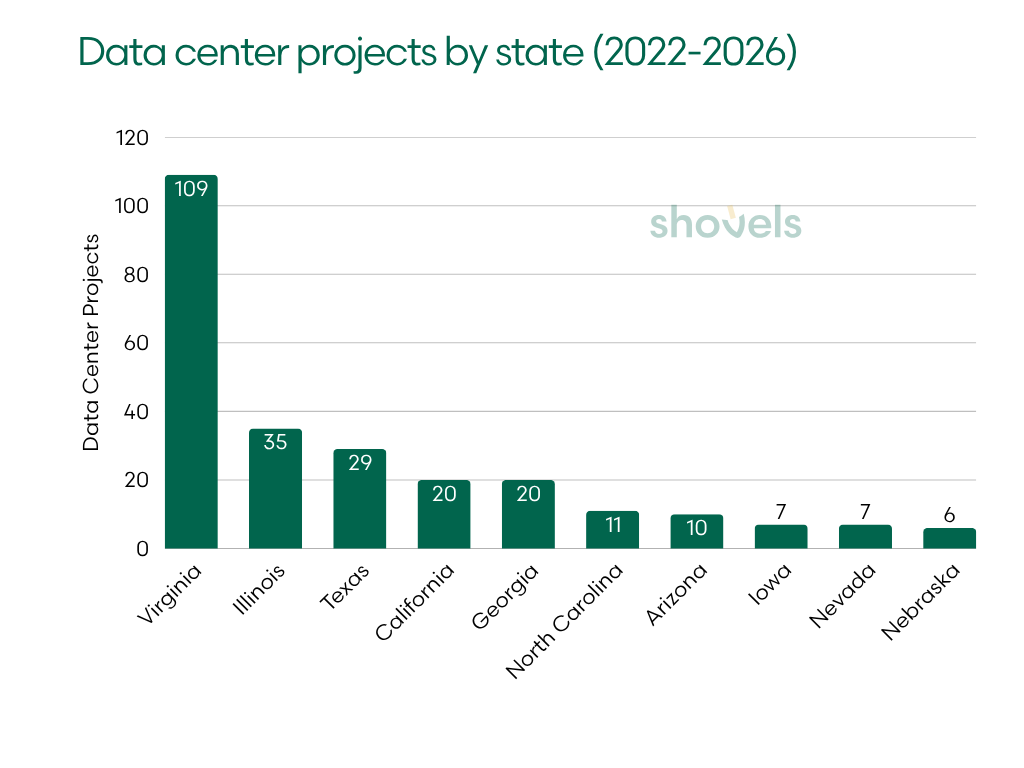
The expansion has yet to displace the industry's established center of gravity. Virginia extended its lead in 2026.
| State | Projects |
|---|---|
| Virginia | 109 |
| Illinois | 35 |
| Texas | 29 |
| California | 20 |
| Georgia | 20 |
| North Carolina | 11 |
| Arizona | 10 |
| Iowa | 7 |
| Nevada | 7 |
| Nebraska | 6 |
The state accounts for 109 of the 295 projects tracked since 2022, roughly three times the total of the next state. Nebraska and Nevada are the newest entrants at this scale, neither of which appeared in our June analysis.
Local rule changes are outpacing the buildout
The permit data show an industry spreading outward. The decisions data show local governments moving even faster to govern it.
To separate that shift from growth in our own coverage, we compared the same 285 jurisdictions across the January-to-July window in both 2025 and 2026. Each recorded at least 50 decisions in both periods; jurisdictions added between the two windows were excluded.
| Jan-Jul window | All decisions | Data center decisions | Data center share | Jurisdictions with at least one |
|---|---|---|---|---|
| 2025 | 80,667 | 92 | 0.11% | 50 |
| 2026 | 117,377 | 349 | 0.30% | 111 |
Within this fixed panel, data center matters rose 2.6 times as a share of all local decision-making. The number of jurisdictions with any data center decisions more than doubled, from 50 to 111. Total decision volume grew 1.5 times over the same period, making the change in share more revealing than the raw count alone.
The same acceleration is visible in outside reporting. Data Center Watch counted at least 75 projects worth roughly $130 billion blocked or delayed in the first quarter of 2026 alone, and Brookings now describes data centers and electricity costs as a top issue heading into the 2026 midterms.
Construction is still expanding. The regulatory response is expanding faster.
Moratoriums are now more than a quarter of all data center decisions
Public response is increasingly taking the form of a moratorium. The measures attract attention because they stop the development clock, and until this year, they were relatively rare.
Within the same panel of 285 jurisdictions, exactly one data center decision involved a moratorium in the first seven months of 2025. During the same period in 2026, 98 did. As a share of all data center decisions, moratorium activity climbed from roughly 1% to 28%.
| Jan-Jul window | Data center decisions | Moratorium-related | Share |
|---|---|---|---|
| 2025 | 92 | 1 | 1.1% |
| 2026 | 349 | 98 | 28.1% |
The measures reach across the development process:
- Nashville passed a July ordinance temporarily halting the acceptance, processing, approval, and issuance of zoning, building, and grading permits for data centers.
- Memphis approved a similar measure on first reading in August.
- Tallmadge, Ohio, enacted a six-month pause on data center zoning applications.
- Prince George's County, Maryland, adopted a two-year moratorium aimed specifically at hyperscale facilities.
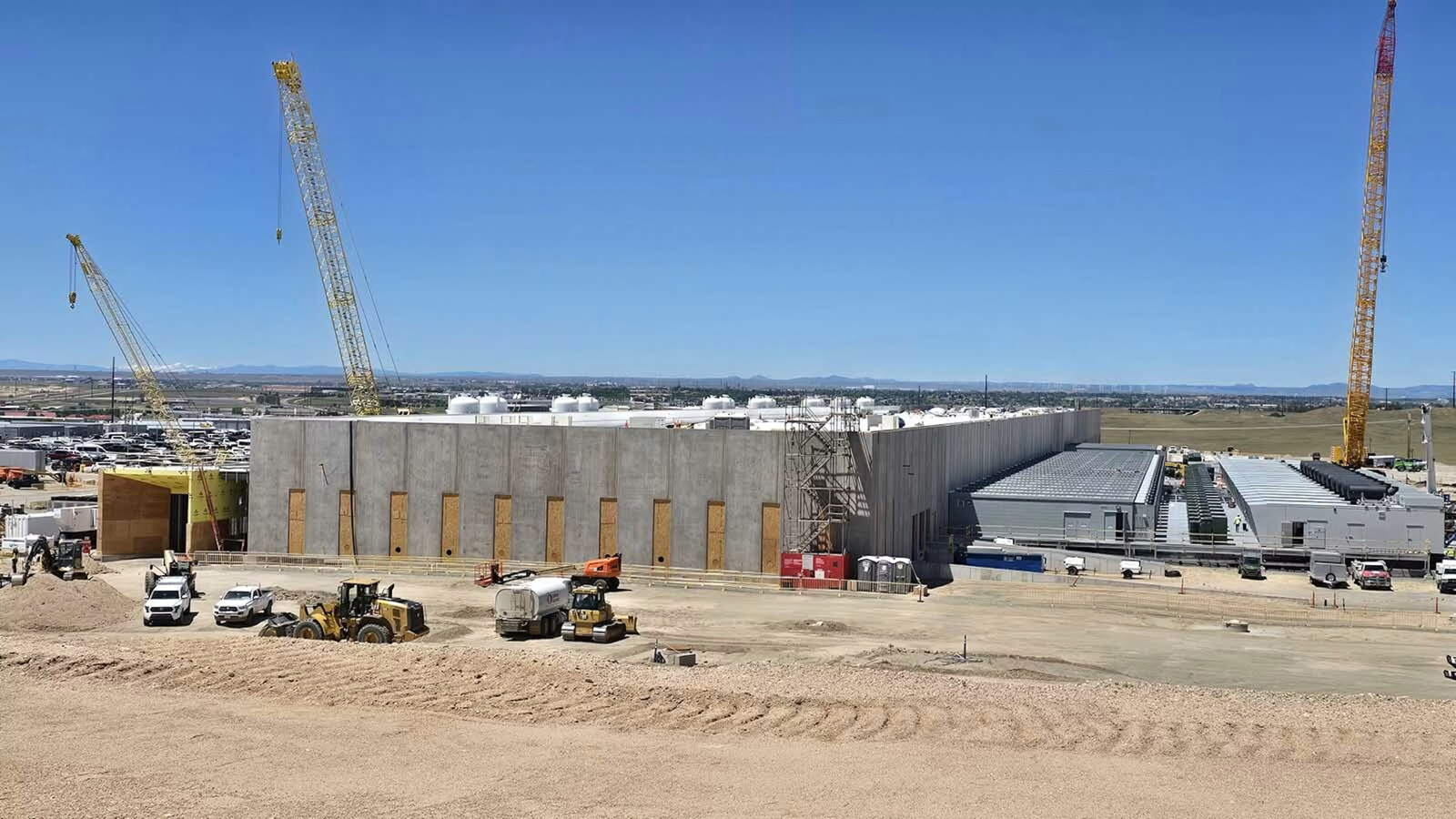 An image of Related Digital’s data center for CoreWeave near Cheyenne, Wyoming. Microsoft is moving forward with a hyperscale campus nearby. Image: Cowboy State Daily.
It’s also important to note that not every proposed pause becomes law. In May, Cheyenne, Wyoming, for example, rejected a 12-month moratorium after a lengthy public hearing. Its sponsor cited rapid land consumption, water use, and the prospect of 40 to 70 data centers. Opponents pointed to the potential economic benefits. Seven weeks later, the council voted 6–3 to annex 3,459.99 acres east of South Greeley Highway for a Microsoft hyperscale campus. The pause reached the agenda, but not the code.
Most moratoriums are scaffolding for a code rewrite
When a moratorium passes, it is rarely the whole policy. Most describe themselves as a temporary measure designed to hold applications in place while officials write codes and regulations that would become permanent. Looking at all data center decisions since 2022, we found that over half of moratoriums are paired with an ordinance.
| Step | Decisions | Share of previous step |
|---|---|---|
| All data center decisions | 1,422 | - |
| Mention a moratorium | 341 | 24% |
| Of those, a pause tied to drafting or reviewing standards | 177 | 52% |
| Of those, a separate ordinance in the same jurisdiction within six months | 81 | 46% |
More than half of the moratoriums in the dataset explicitly say they exist to buy time while staff draft standards, develop regulations, update the zoning code, or complete a study. The pause is not the finished policy. It is the scaffolding around one being built.
The timing shows that, in many places, the underlying policy work has already begun by the time the pause is adopted. In more than half of the matched cases, the ordinance came first by a median of about seven weeks.
| When the ordinance lands | Moratoriums | Median gap |
|---|---|---|
| Before the moratorium | 45 | 49 days |
| After the moratorium | 19 | 35 days |
| Same meeting | 17 | 0 days |
The jurisdiction was already rewriting its code when the moratorium arrived to hold applications in place. Seventeen jurisdictions adopted both at the same meeting.
That overlap helps explain why zoning code modifications are the largest category in the dataset. Of the 671 code modifications tracked, 290 carry moratorium language. The share rose from none in 2024 to 29% in 2025 and 46% so far in 2026. Increasingly, the code amendment and the pause arrive as a single piece of council business.
Moratoriums leading to new frameworks
A moratorium expires, but a rewritten zoning code becomes the framework for every application that follows.
For example, Hancock County, Georgia, lifted its data center moratorium and adopted the special use permit regulations that replaced it in the same meeting. Linn County, Iowa, which contains Cedar Rapids, adopted a data center ordinance in February 2026 requiring large projects to complete a water study, sign a water use agreement covering drought protocols, and sign an economic development agreement funding community infrastructure. The ordinance was followed in July by an 18-month pause on large-scale rezonings while the county evaluates cumulative impacts. Linn County ran the common sequence: ordinance first, pause second.
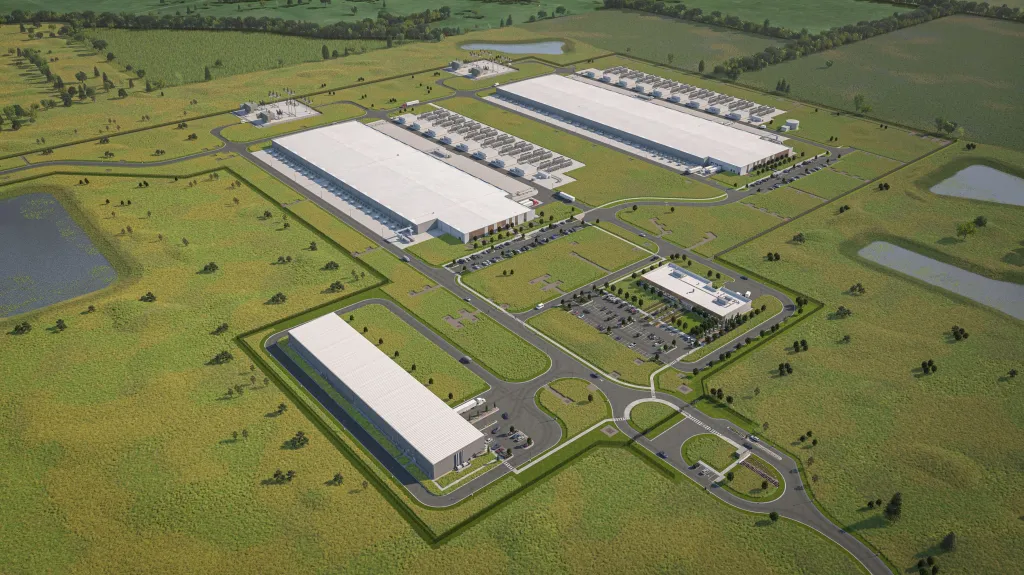 Meta’s data center in Montgomery, Alabama. Up the state, Birmingham passed a strict ordinance with conditions for future data centers. Image: Meta.
Birmingham passed a moratorium first. The city suspended data center development in March 2026 while it studied energy and water impacts, then in June passed what it calls Alabama's toughest data center zoning ordinance on a 6-3 vote, with twenty conditions including a 500-foot residential setback, a five-acre minimum, closed-loop cooling, and a prohibition on gas turbines. The pause was temporary. The ordinance is not.
There is a legal logic to approaching applications this way. As one Pennsylvania municipal law practice puts it, "Amendments adopted before an application arrives carry real legal weight", while amendments written in reaction to a filed application are harder to defend. Brookings makes a parallel argument from the policy side, that moratoriums are not a substitute for oversight and function best as time bought to build a permanent framework.
Local governments also don’t have to devise their rules from scratch. Model ordinances and planning guides now circulate through national associations and county planning commissions, from a NACo primer for county officials to a joint Montgomery and Chester County ordinance guide in Pennsylvania created specifically to help municipalities prepare before development arrives. A jurisdiction with no operating data centers can now adopt a detailed regulatory framework in a single meeting.
In that context, the surge in code modifications looks less like simple opposition than an effort to prepare for development at scale. Jurisdictions are creating durable frameworks while they still have the discretion to do so.
Established hubs such as Virginia, Illinois, and Texas started from a different position. Many foundational zoning and infrastructure questions were settled years ago. That regulatory head start helped those markets absorb and green-light so much construction in the first place.
Want to see which jurisdictions are writing data center rules before applications arrive? Shovels Decisions covers zoning votes, code amendments, planning commission rulings, and moratoriums across US jurisdictions, then pairs them with permit data to show where the rules are changing ahead of the buildout. Contact us to learn more.
The buildout is spreading, but approvals are also slowing
Ask how long it takes to permit a data center and the usual answer is six to eighteen months, a figure that circulates widely in trade coverage without an underlying dataset behind it. It also does not describe a building permit.
A data center passes through several approvals running on very different clocks. Collapsing them into a single number is why the public conversation about data center permitting is so muddled.
| Stage | Typical duration | What it decides |
|---|---|---|
| Entitlement, rezoning, special exception | Months to years | Whether the use is allowed at all |
| Building permit | Same day to roughly three months | Whether the plans meet code |
| Grid interconnection | Up to eight years in PJM territory | When the building can actually run |
Shovels measures the middle clock, and that precision cuts against some widely repeated claims. Loudoun County is routinely described as a jurisdiction where approvals now stretch six to twelve months. Its data center building permits have had annual median approval times between 29 and 112 days since 2022, including 43 days in 2025. Both descriptions can be accurate, because they are timing different stages. The months belong to the entitlement process. The building permit is the last and shortest step.
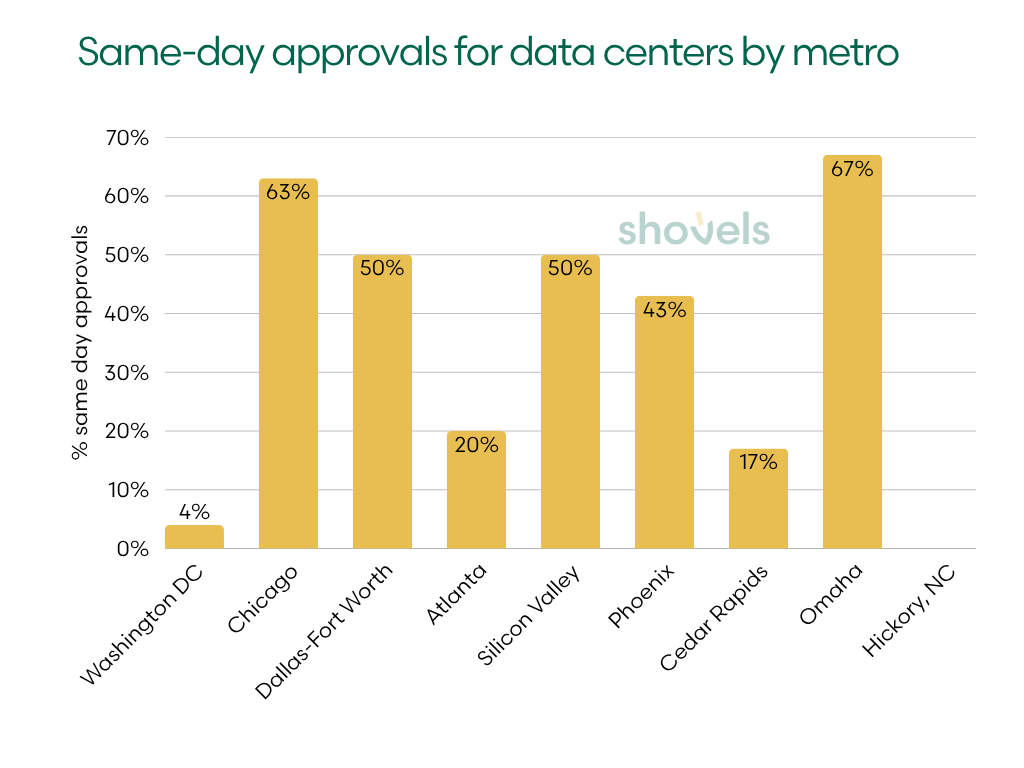
| Metro | Projects | Approved same day |
|---|---|---|
| Washington DC | 106 | 4% |
| Chicago | 31 | 63% |
| Dallas-Fort Worth | 25 | 50% |
| Atlanta | 19 | 20% |
| Silicon Valley | 16 | 50% |
| Phoenix | 10 | 43% |
| Cedar Rapids | 7 | 17% |
| Omaha | 6 | 67% |
| Hickory, NC | 5 | 0% |
This spread will be affected as moratoriums and code rewrites grow. A same-day permit is only possible where a project is already by-right, with the zoning question settled long before the application arrives. Every ordinance in the previous sections removes that possibility for some class of project, moving it from the fast clock to the slow one.
Fort Worth offers the clearest illustration of the turn. In June, we highlighted its expedited review program, which allowed projects that had cleared zoning to receive same-day building permits. On August 11, 2026, the city council voted unanimously to begin a 90-day moratorium process on data center construction, created a Data Center and Infrastructure Committee, and cited concerns about noise, long-term water availability, and land use compatibility. The pause would take effect in February 2027 and exempt applications already submitted, but Dallas-Fort Worth's median approval time has moved from same-day to 18 days.
The state layer also shifted at the same time. In August 2026, Governor Abbott directed the PUCT and ERCOT to pause pending data center interconnection requests until each project completes an audit, alongside standards requiring data centers to fund their own electric infrastructure and reuse water.
Illinois moved in a similar direction with a proposed two-year pause on state data center tax incentives. These are upstream constraints whose effects may not appear in building-permit data for several quarters.
Ordinances passed in 2026 do not yet appear in these figures, because the permits they govern have not been filed. The building permit is the last clock to register a change in the rules, and the largest wave of rule changes is still upstream of it.
What this means for developers, site selectors, and utilities
The data center buildout and local government regulation are both expanding, but they are moving on different timelines and across different maps.
For site selectors, local sentiment and increased regulations will play a large part in future planning. Michigan offers the clearest example: it ranks among the country's most restrictive states. Independent inventories count two operating data centers totaling 4 MW, but the state has 16 projects stalling. Find out whether a jurisdiction has already written its rules and what those rules require. This will expedite the actual buildout. Water-use agreements and community infrastructure commitments are harder to negotiate after a site has been selected.
For developers and contractors, mature corridors may remain more predictable than frontier markets. It’s not always true that mounting friction will simply push projects toward the periphery. Virginia absorbed more volume than any other state while adding review layers because its utilities, contractors, and planning departments already know how to process these projects. When the zoning question is already settled, developers will face a shorter, more predictable timeline.
For utilities, the critical constraint is moving from the building department to the interconnection queue. Texas's pause on interconnection requests pending audit, for example, is a different kind of gate from a zoning hearing. Its effect may not appear in permit data for years.
Finally, the real test will come when new frameworks meet new applications at scale. Many have not yet been tested against a developer with financing, utility capacity, and a specific site. When they are, the permit record will show whether the rules channel or expedite projects—or discourage developers entirely. Until then, the clearest signal is the race between an industry still expanding and the governments determined to set their terms.
Tracking data center development or the rules being written around it? Shovels covers building permits and municipal decisions across the US, updated twice monthly. Contact us to talk through your use case.
Frequently Asked Questions
- How many data center permits has Shovels tracked since 2022?
-
Shovels tracked 295 data center projects permitted between January 2022 and July 2026. Filings kept expanding in 2026: the first seven months included 63 projects, 29% ahead of the same period in 2025, and the footprint widened from 13 states to 19.
- Are data center moratoriums slowing construction?
-
Not yet at the national level. Data center project filings in the first seven months of 2026 ran 29% ahead of the same period in 2025 even as local rule-making accelerated.
- How common are data center moratoriums?
-
Much more common than a year ago. Moratorium activity rose from roughly 1% of data center decisions in the first seven months of 2025 to 28% in the same period of 2026. Across 2026, 313 moratorium measures came before local governments in 138 jurisdictions.
- Do cities regulate data centers before any are built?
-
Often, yes, and there is a legal incentive for the timing: zoning amendments adopted before an application arrives are easier to defend than amendments written in response to a pending one. Model data center ordinances now circulate through groups like NACo and county planning commissions, several written expressly to help municipalities prepare for development that has not yet arrived. Michigan is a clear example, with dozens of local moratoriums and just two operating data centers statewide.
- How long does it take to get a data center building permit approved?
-
It depends on which permit. The entitlement or special exception that decides whether a data center is allowed at all commonly runs months to years. The building permit that follows is much shorter: 63% of Chicago's data center permits are approved the same day, against 4% in Washington DC. Grid interconnection is the longest clock of all, reaching eight years in PJM territory.
- Why did Fort Worth pass a data center moratorium?
-
On August 11, 2026, the Fort Worth City Council voted unanimously to begin a 90-day moratorium process, citing noise, long-term water availability, and land use compatibility, and created a Data Center and Infrastructure Committee. The pause takes effect in February 2027 and exempts applications already submitted. Dallas-Fort Worth's median approval time has moved from same-day to 18 days.
- What is the difference between a moratorium and a zoning code modification?
-
A moratorium is a temporary pause on applications that expires. A zoning code modification permanently changes what may be built and under what conditions. In practice the two are usually the same act: 290 of the 341 moratorium records in our data, or 85%, are filed as zoning code modifications, and 43% of all code modifications carry moratorium language.