


This month, I'm writing to you about AI. I've taken the bait, I'm adding another hot take to the endless pile of hot takes. Before I lose you, let me entice you with two ideas: taste and credit cards.
Yes, taste and credit cards. They are two of the most important topics I see in the AI-driven future for both of our companies, mine and yours.
I'll explain below!
A permanent place for taste
Last Saturday, perfectly nestled in my calendar between a 4th grade and a 6th grade soccer game, I spoke about AI at a virtual conference for the AEC community. It was a fun and wide-ranging discussion, but the part that I remember most is when the host asked me how AI is impacting our hiring plans at Shovels.
I can't speak to call centers and content farms because I don't run one, but I can speak to data and software companies, and to that I can definitely say the hiring is accelerating. The AI creates a bigger pie, and this pie is addictive. The more people we hire, the more big expanding pies we get.
The AI alone doesn't create the pie. It's the human and AI together that make it. To take this analogy all the way, without the human, the AI is just a tasteless crust. It's bland, it's dry, and it all looks the same. A creative, intelligent human fills it in and makes it valuable.
The point is this: taste. A self-driving AI, or an AI that drives the human (a.k.a. "vibe coding") has no taste. It converges to the mean, it all looks and feels and does the same thing. Bland, boring, frustrating, dry. Even the best AI can't substitute human taste. I venture to guess it never will.
The role for us, with all the fancy AI productivity, brainstorming, and acceleration, is to provide the taste.
Without it, our AI-driven work is just a stale, janky crust.
The birth of agentic payments
Okay, now to credit cards.
We use a neo-bank called Mercury for moving money around. It's a super successful startup. One of our earliest investors also invested in Mercury, and we're trying to get some of that juju.
When we sign up for new services, we usually make a dedicated credit card for it. This way if the card is ever leaked, we can lock it down without disrupting every other subscription. It also helps to force a cancellation if we get locked out.
Anyway, the last time I went into Mercury to make a new credit card, I saw the future. The future is this:
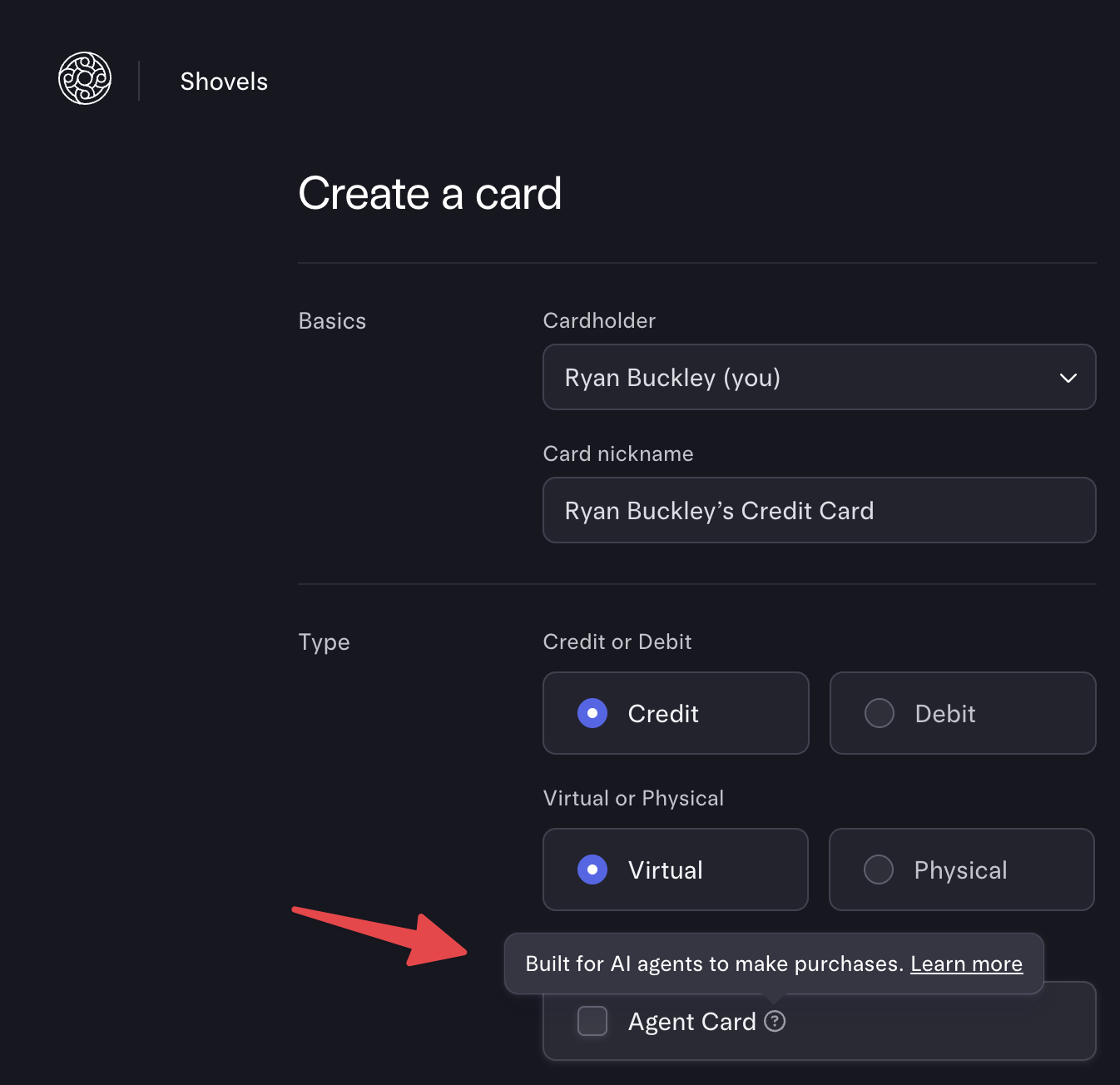
I see a future where everyone's research agent has a budget. The budgets are controlled by the credit card companies and neo-banks like Mercury, Ramp, and Brex, and rules can be set to restrict what it can buy. You can write rules into the prompt and enforce them here at the bank level.
For architecture, engineering, and construction agents, a layer of ground truth is necessary for all of your research. You will have your very own AI agent. Your agent will support your work. It will look things up, check your email, help you prep for meetings, and even write reports.
These reports will require data. That data, the best data, the data you need to do your best work (with taste!) will not be free. It will not be free because it will be processed, enriched, stitched together across thousands of jurisdictions and dozens of datasets. It might come from Shovels.
The best, most valuable data requires payment. Your agent will use its intelligence to evaluate and purchase this data. Eventually you'll simply tell it, "Go to Shovels and look up this information. Use your approved budget to get what you need."
On our side, we'll have this agent-friendly infrastructure available. We'll give the agent what it needs: a sample, a download link, and a payment receipt.
That's it! That's the future and it'll be here soon. I bet we'll do our first transaction like this in 2027.
Taste and credit cards, one inherently human, the other inherently digital. The future is both.
P.S. Will you be at the Blueprint conference on Sep 22-24 in Las Vegas? Ping me to meet up!