


This analysis draws on Shovels permit and decisions data available at the time of writing, which offers extensive but not complete market coverage. Findings reflect our interpretation of that data and are not investment advice or a guarantee of future outcomes.
On August 7, 2026, Dream Finders Homes agreed to acquire Beazer Homes for $33.50 per share in cash, valuing Beazer at roughly $2.2 billion in enterprise value. The agreement came after six previous offers over six months. It combines Dream Finders' 8,608 single-family closings in 2025 with Beazer's 4,427 in fiscal 2025, creating one of the largest homebuilders in the United States.
While closings scope the size of the combined company, they don’t always show where each builder is active today or how much their operations overlap.
Permit records can help fill in that operating picture. We analyzed 3,440 permits tied to Dream Finders, Beazer, and their subsidiary entities between July 2025 and June 2026, using the same approach we applied when Berkshire Hathaway acquired Taylor Morrison.
We found that the deal expands both the scale and geographic reach of the combined company, with relatively little overlap between the two builders. Permit and land-use decisions also show where integration could create efficiencies and where growth may emerge. Here’s a closer look.
How we built this
We matched permits to the builders using contractor business names, applicant names, DBAs, and known subsidiaries. For Dream Finders, those entities include Coventry Homes, DFH Crescent, and DFH Coventry. For Beazer, they include Beazer Homes Holdings and Beazer Homes Texas LP. All counts use permit start dates from July 2025 through June 2026.
We deduplicate projects at the address level based on the most recent permit per project, so the map approximates one point per home under way.
That said, there are two honest caveats: some points represent a trade permit where the master new-construction permit hasn't appeared yet, and some brand-new addresses don't geocode. They either can’t be added or fall back to approximate locations. Our jurisdiction coverage, while broad, is not fully comprehensive. Think of this map as a highly representative sample rather than a complete census.
What Dream Finders and Beazer each bring to the table
Between July 2025 and June 2026, we tracked 2,006 permits for Dream Finders and 1,434 for Beazer, for a combined total of 3,440.
When we put the footprints side by side, the geographic logic of the deal quickly became clear. This is primarily an acquisition of new territory, not a consolidation of markets where Dream Finders already has scale.
Interactive map: Dream Finders permits, July 2025 to June 2026
Interactive map: Beazer permits, July 2025 to June 2026
| State | Dream Finders | Beazer |
|---|---|---|
| CO | 552 | 0 |
| NC | 413 | 76 |
| TX | 401 | 359 |
| FL | 389 | 197 |
| SC | 108 | 0 |
| GA | 41 | 51 |
| TN | 35 | 66 |
| VA | 32 | 130 |
| AZ | 28 | 32 |
| MD | 7 | 15 |
| NV | 0 | 271 |
| CA | 0 | 211 |
| IN | 0 | 25 |
| OH | 0 | 1 |
| Total | 2,006 | 1,434 |
Permits with a start date between July 2025 and June 2026, in jurisdictions Shovels covers.
Two parts of the table clearly capture the value each company brings.
Beazer boasts significant new construction activity in the West, where Dream Finders has almost no presence. It accounts for 271 permits in Nevada, all in Las Vegas, and 211 in California, split between Sacramento and Riverside-San Bernardino. These are not markets that Dream Finders was gradually entering. They represent entirely new territory.
Colorado, by contrast, is Dream Finders' largest state in our sample, with 552 permits across Denver, Fort Collins, and Boulder. Beazer has no presence there. The combined company's Colorado business comes entirely from Dream Finders.
Dream Finders and Beazer share nine metros
We also took a closer look at states where both builders operate. While Dream Finders and Beazer do overlap, the builders do not always compete for the same buyers, trade crews, or lots.
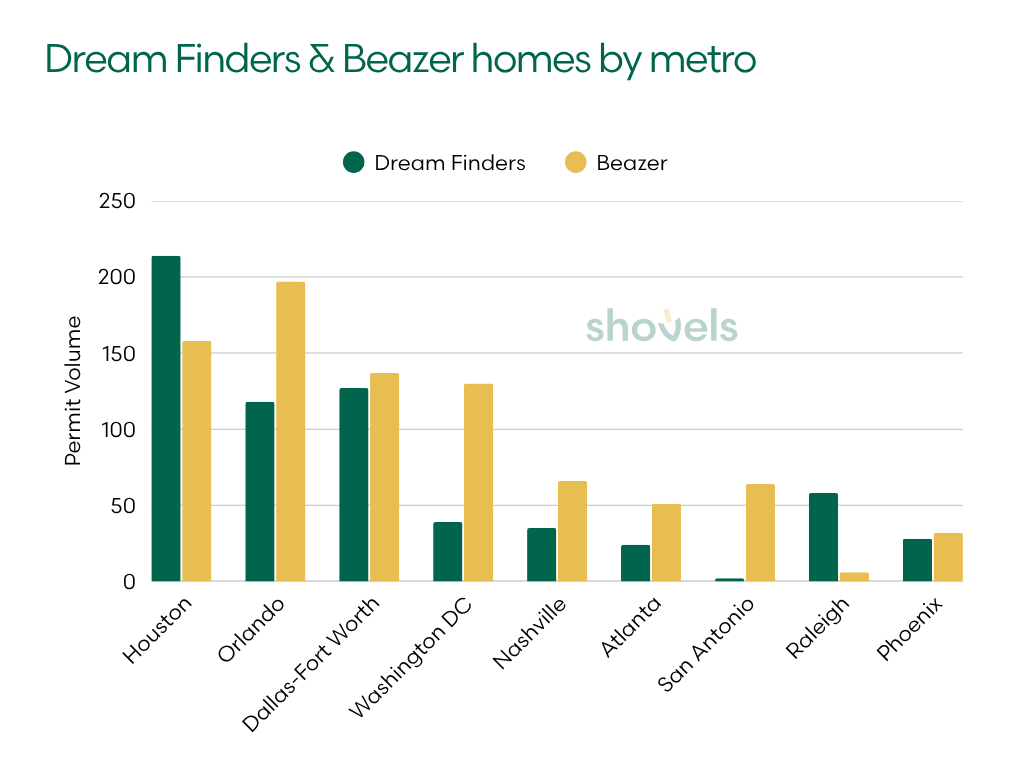
At the metro level, their shared footprint is much smaller than the state table suggests. Both companies pull permits in only nine metros, out of roughly 40 where at least one is active. In four of the nine, one builder is more than double the other.
| Metro | Dream Finders | Beazer |
|---|---|---|
| Houston | 214 | 158 |
| Orlando | 118 | 197 |
| Dallas-Fort Worth | 127 | 137 |
| Washington DC | 39 | 130 |
| Nashville | 35 | 66 |
| Atlanta | 24 | 51 |
| San Antonio | 2 | 64 |
| Raleigh | 58 | 6 |
| Phoenix | 28 | 32 |
Orlando is an interesting market to watch. Beazer builds in only one Florida metro, as its 10-K market table confirms. Its 197 permits there exceed Dream Finders' 118. Dream Finders operates across eight Florida metros, including Sarasota, Punta Gorda, Tampa, and Jacksonville, but in the one market they share, the seller outbuilds the buyer.
The Carolinas split down the middle. In Raleigh-Cary, Dream Finders holds 58 permits to Beazer's 6. Twenty-five miles away in Durham-Chapel Hill, Beazer holds 70 and Dream Finders has none. The permit record reveals two adjacent metros with almost opposite footprints.
Texas splits three ways. Houston and Dallas-Fort Worth are genuinely shared. San Antonio is effectively Beazer's, with 64 permits to Dream Finders' 2, while Austin belongs to Dream Finders alone, 58 to zero.
Phoenix is the only Western market where both already operate. Dream Finders launched a Phoenix division in July 2024, with activity concentrated in the city of Maricopa in Pinal County. Beazer's Arizona permits sit mostly in Buckeye. The builders share the metro, but operate in different corners of it. Everywhere else in the West, the deal gives Dream Finders a clean entry into a new market.
Decisions reveal different land strategies
Permits show where a builder is active today. The earlier signal appears before planning commissions and county boards, where rezonings, plats, and other land-use decisions reveal where it may build next. Those are the records Shovels Decisions captures.
A builder that owns land is more likely to appear in rezonings and plats than one that primarily controls lots through options. Over the same July 2025 to June 2026 window, Beazer shows up in 24 land-use decision records in our data. Dream Finders appears in only 3. That difference speaks to the diverging land strategies both builders adopt: Dream Finders prefers to option lots while Beazer buys ground and works it through the approval process itself.
A representative case is a three-step sequence in North Las Vegas. On November 12, 2025, Beazer Homes Holdings filed a tentative map for a 20-lot single-family subdivision on 4.05 acres at Lone Mountain Road and North 5th Street. On December 17, the city approved a general plan amendment and rezoned the site from neighborhood commercial to low-density single-family residential.
Our read on why Dream Finders made the move
We’re a data platform and not investment analysts, and we are not providing investment advice. But our read of the permit record points to three factors driving acquisition.
It buys entry, not redundancy. Beazer gives Dream Finders established operations in Las Vegas, Sacramento, and Riverside, eliminating the need to build new divisions from scratch. The markets also align with Dream Finders’ focus on entry-level and first-time move-up buyers, offering relatively affordable alternatives to Los Angeles and the Bay Area. Founder and CEO Patrick Zalupski has said the combined company will have "the scale to compete" nationally.
It is a land deal as much as a homebuilding deal. Dream Finders operates a fully land-light model, while Beazer owns roughly 40% of its lots. The transaction adds 24,489 owned and controlled Beazer lots. HousingWire expects most to be land banked through Dream Finders' $1.25 billion arrangement with Millrose Properties, converting Beazer's owned land into the structure Dream Finders already uses.
Thin overlap cuts both ways. It limits cannibalization, but also leaves few places to produce savings by combining local divisions and trade bases. Dream Finders expects more than $100 million in annual run-rate savings. In the permit data, only Houston and Dallas-Fort Worth have two operations of comparable scale. Much of the remaining savings will have to come from purchasing, overhead, and the elimination of duplicate public-company costs.
What to watch after the deal closes
Beazer's quarterly filings, investor presentations, and earnings calls will disappear after the deal closes. Its permit trail will not. Construction permits and land-use decisions remain public regardless of who owns the company, giving suppliers, competitors, investors, and land teams a way to keep tracking the business.
Three signals will be especially important:
Whether the acquired markets hold. Las Vegas, Sacramento, and Riverside represent much of the new territory Dream Finders is buying. Their permit activity will show whether those operations maintain momentum through the integration.
What changes in Houston, Dallas-Fort Worth, and Orlando. These are the only metros where two substantial operations overlap. If divisions, trade bases, or local pipelines consolidate, the effects should appear here first.
Where the combined company enters next. The most valuable signal is not always volume. A builder pulling permits in a jurisdiction where it had no activity a year earlier can reveal its land strategy before an announcement does.
That is the broader value of the public record: it shows not only what Dream Finders is buying, but what happens to the business next.
Frequently Asked Questions
- Is Dream Finders buying Beazer Homes?
-
Yes. On August 7, 2026, Dream Finders Homes agreed to acquire Beazer Homes for $33.50 per share in cash, valuing Beazer at approximately $2.2 billion in enterprise value. The agreement followed six prior offers over six months. Beazer will delist from the NYSE when the deal closes.
- How large is the combined Dream Finders-Beazer company?
-
The two builders closed 13,035 homes in their most recent fiscal years: 8,608 for Dream Finders in calendar 2025 and 4,427 for Beazer in fiscal 2025. The companies announced the deal as creating the sixth-largest U.S. homebuilder. ResiClub ranks the combination seventh and HousingWire eighth, depending on how Berkshire Hathaway's builder holdings are counted.
- Where does Beazer Homes build?
-
According to Beazer's fiscal 2025 10-K, its markets include Phoenix; Riverside-San Bernardino, Sacramento, and San Diego; Las Vegas; Dallas-Fort Worth, Houston, and San Antonio; Indianapolis; Baltimore, Salisbury, and Washington, D.C.; Nashville; Orlando; Atlanta; Raleigh-Durham; and Charleston and Myrtle Beach. In Shovels permit data for the trailing twelve months, Beazer's largest state footprints are in Texas, Nevada, California, and Florida.
- Where do Dream Finders and Beazer overlap?
-
The builders overlap in nine metros: Houston, Orlando, Dallas-Fort Worth, Washington, D.C., Nashville, Atlanta, San Antonio, Raleigh, and Phoenix. In four, one builder has more than twice the permit activity of the other. Beazer's Nevada and California markets have no Dream Finders activity, while Dream Finders' Colorado markets have no Beazer activity.
- Can you still track a homebuilder after it is acquired?
-
Yes. Permits are filed with local jurisdictions under operating entities, and land-use decisions are public records, so a builder's activity stays visible regardless of ownership. Beazer files under names including Beazer Homes Holdings and Beazer Homes Texas LP, and those filings continue through and after a transaction.