


This analysis draws on Shovels permit and decisions data available at the time of writing, which offers extensive but not complete market coverage. Findings reflect our interpretation of that data and are not investment advice or a guarantee of future outcomes.
On June 1, 2026, Berkshire Hathaway announced a definitive agreement to acquire Taylor Morrison Home Corporation for $72.50 per share in cash, roughly $6.8 billion in equity value and $8.5 billion in enterprise value. It's the first major acquisition under new CEO Greg Abel, and Berkshire has signaled plans to bring Taylor Morrison alongside its existing site-built homebuilding operations under Clayton Homes.
The deal is expected to close in the second half of 2026, when Taylor Morrison, America's sixth-largest homebuilder with 12,997 closings in 2025, will go private and delist from the NYSE. Combined with Clayton Properties' 9,953 closings, Berkshire Hathaway will become the nation's fourth-largest homebuilder overnight, according to ResiClub, trailing only D.R. Horton, Lennar, and PulteGroup.
The announcement hit on a Monday. By that afternoon, our team had already mapped every Taylor Morrison new-construction permit we've tracked this year. That's the focus of this post: when a major event reshapes the housing industry, permit data offers the clearest lense to understand what it means on the ground.
What Berkshire bought, according to the permits
Interactive map: Taylor Morrison permits Jan-May 2026
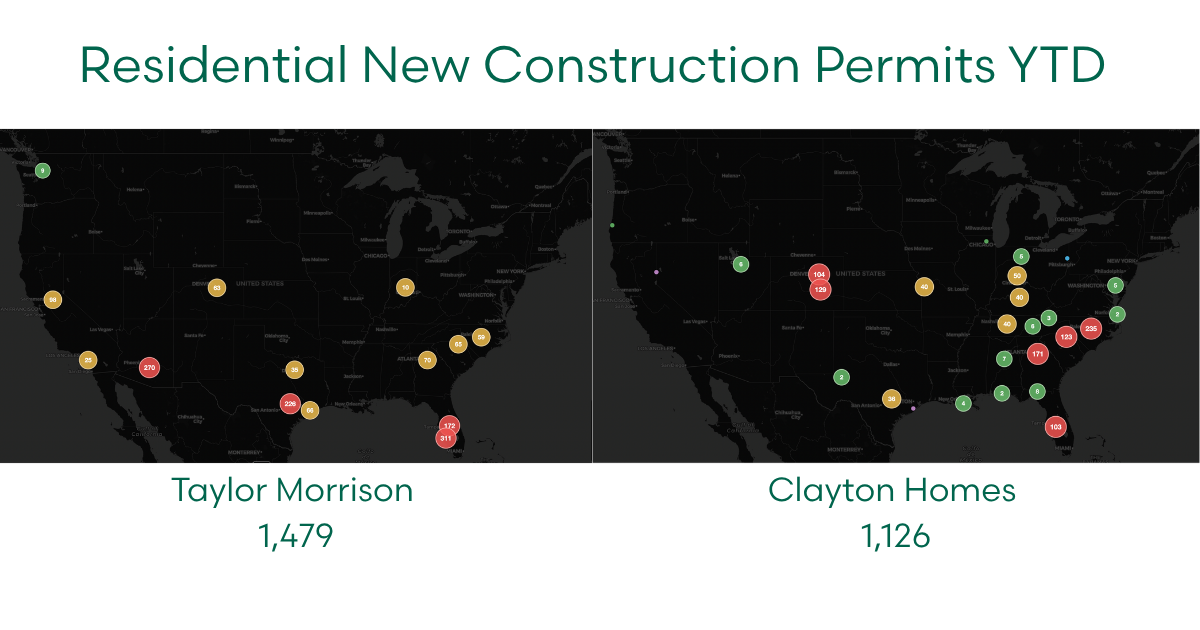
We track 1,311 residential new-construction permits associated with Taylor Morrison and its subsidiaries from January through May 2026. The clearest takeaway is that Taylor Morrison's footprint is concentrated in high-growth Sunbelt markets.
Florida (390 permits), Texas (327), and Arizona (252) account for roughly three-quarters of the company's permit activity in our coverage. The remainder is spread across California, North Carolina, Colorado, and Georgia. At the metro level, activity clusters around fast-growing suburban markets in Phoenix, Texas, and the Carolinas. These are places where population growth, job creation, and housing demand are driving new development.
Their Florida footprint confirms their customer base. Taylor Morrison's Florida permits are concentrated in the Gulf Coast (Sarasota, Bradenton, Lakewood Ranch, Fort Myers, Punta Gorda) rather than the Orlando corridor where other production builders are active. That's consistent with their reputation in the industry: a builder weighted toward move-up buyers, luxury, and resort and 55+ communities. Taylor Morrison does build entry-level homes, but less aggressively than other national builders. They also have a lighter presence in the Northeast and California.
Permit activity remains steady through the spring. We tracked 239 permits in January, 262 in February, and 327 in March. Counts appear lower in April and May, but we view that primarily as a reporting artifact. Permit data arrives on different schedules across jurisdictions, and our dataset refreshes twice monthly. Given the timing, we do not interpret the recent decline as evidence of a slowdown.
How we built this map
To create this map, we matched permits to Taylor Morrison using keyword matching across multiple fields we collect from jurisdictions and contractor records. They include contractor business name, contractor name, applicant name, DBA, and applicant contact details. We also cover known subsidiaries.
We deduplicate projects at the address level based on the most recent permit per project, so the map approximates one point per home under way.
That said, there are two honest caveats: some points represent a trade permit (say, HVAC) where the master new-construction permit hasn't appeared yet, and some brand-new addresses don't geocode precisely and fall back to approximate locations. Our jurisdiction coverage, while broad, is not fully comprehensive. Think of this map as a highly representative sample rather than a complete census.
Our read on why Berkshire made the move
We're a data company, not investment analysts, but the permit data does suggest a few reasons the deal may make strategic sense.
It's a demographics play. Taylor Morrison's footprint is heavily weighted toward the buyers who currently have the money: Gen X and boomer move-up buyers, resort and 55+ communities, and higher-end markets. These are homeowners who have benefited most from a decade of home-price appreciation and stock-market gains. Long-term housing demand increasingly comes from older, wealthier households, and Taylor Morrison is well positioned to serve it.
It complements Clayton's position in the market. Berkshire already owns Clayton Homes, whose site-built and manufactured housing business serves first-time, affordability-driven buyers, and whose permit footprint we see concentrated in markets like the Carolinas, Georgia, and Indianapolis. Taylor Morrison sits at the other end of the spectrum. Together, the two cover both ends of the market at a moment when affordability pressure is squeezing the entry level and builders are finding better margins in higher-value homes.
Hard assets at a soft-market price. Homebuilder equities have underperformed after the building boom of the early 2020s. Taylor Morrison's value isn't just in current home sales. It's also in the land, lots, and future communities. Berkshire has a long history of acquiring businesses and assets it believes are undervalued relative to their long-term potential. This deal appears consistent with that approach.
It adds momentum to an industry that is already consolidating. Building-products distribution has been consolidating for the better part of a decade, and homebuilding is now catching up fast. ResiClub's breakdown of the deal tallies the wave: four US homebuilders acquired by Japanese firms in a five-week window this spring (Japanese-owned builders now build close to 6% of US single-family homes), plus Dream Finders' three runs at Beazer. Taylor Morrison's acquisition is the biggest yet: a top-six builder changing hands in a single transaction. Based on current trends, we expect the pace to accelerate. Builders outside the top 15 will feel the impact as the biggest players get bigger, and scale brings lower costs.
Why this matters if you compete with Taylor Morrison
Here's what matters for every other builder: Taylor Morrison is about to go private. One consequence is that their quarterly filings, investor presentations, and earnings calls will disappear. But the permit record won't. Construction permits remain public records regardless of ownership structure, which means competitors, suppliers, investors, and land developers can continue to track building activity.
Based on what we see in the data, there are three areas worth watching:
Where they're expanding. Permit volume matters, but new market entry is the more valuable signal. Look at jurisdictions where Taylor Morrison (or any other builder) is pulling permits today where they weren't a year ago. This is land strategy revealing itself in public records, ahead of any press release.
Relative build rate. In today's market, the most important question isn't necessarily who is building the most homes. It's who is gaining or losing momentum. Tracking permit activity by metro area shows you which builders are accelerating, maintaining share, or pulling back.
The Carolinas, specifically. Clayton already has a significant presence there, and Taylor Morrison has been expanding its Southeast footprint. Combined, they have an outsized presence in one of the country's most active homebuilding markets.
The earlier signal: before the permit, there's a decision
A senior data leader at one of the nation's largest homebuilders put it to us this way: homebuilding is really a land business, and the whole game is change detection, knowing the moment a parcel that didn't pencil suddenly does.
His example has stayed with us: a land acquisition manager passes on a parcel because of an entitlement issue and files it away. Months later, the zoning changes, a competitor spots the opportunity, and the parcel is gone before the first team realizes the landscape has shifted.
This is what Shovels Decisions is for. Decisions captures what city councils, planning commissions, and county boards approve (rezonings, entitlements, easements, development agreements) which is where a buildable lot becomes buildable, often months or even years before a permit is pulled.
Taylor Morrison shows up there, too. A quick search of our Decisions data surfaced four recent entitlement records, including a Las Vegas easement vacation for a 30-unit subdivision and a development agreement in Orange County.
But here's what caught our attention. Three of the four were consent-calendar items approved without discussion. There was no transcript to parse because nothing was said. A transcript-only approach would have missed them. The signal lived in the agenda packet and supporting documents.
Watching the watchable
The financial press will spend plenty of time analyzing what this acquisition means for Berkshire Hathaway and Taylor Morrison shareholders.
What permit and decision data reveals is this: where Taylor Morrison is actively building today, how its footprint complements Clayton's, and what its future growth plans may be. And all this, before and during construction begins.
FAQ
What did Berkshire Hathaway pay for Taylor Morrison?
$72.50 per share in cash, approximately $6.8 billion in equity value and $8.5 billion in enterprise value, a 24% premium to the prior close. The deal was announced June 1, 2026 and is expected to close in the second half of 2026.
Where does Taylor Morrison build homes?
Based on Shovels permit data from January–May 2026, Taylor Morrison's residential new-construction activity concentrates in Florida, Texas, and Arizona (~74% of permits we track), with additional activity in California, North Carolina, Colorado, and Georgia, largely in high-growth Sunbelt suburbs and Gulf Coast Florida markets.
Does Berkshire Hathaway own other homebuilders?
Yes. Berkshire owns Clayton Homes, which builds manufactured and site-built homes weighted toward first-time and affordability-driven buyers. Taylor Morrison's move-up and luxury focus sits at the other end of the market.
How can competitors track Taylor Morrison after it goes private?
Building permits and land-use decisions are public records regardless of company ownership. Permit data shows where a builder is actively constructing; decisions data (rezonings, entitlements, development agreements) shows where they're securing land, often well before construction begins.