
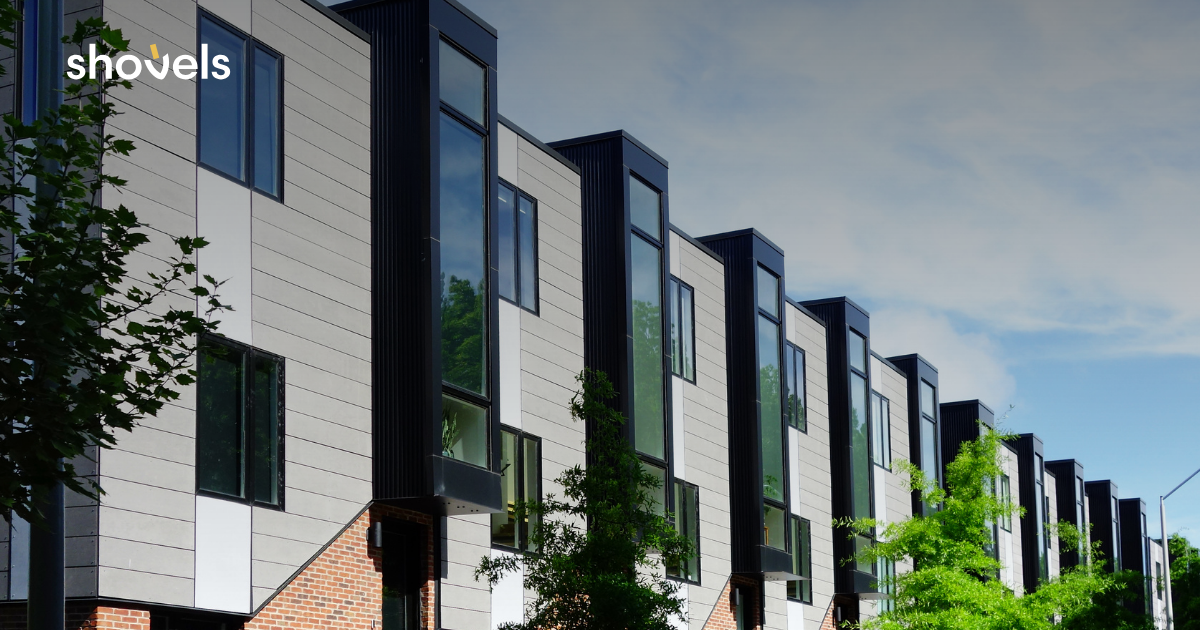

Upzoning is the practice of changing a property's zoning to allow denser or more intensive development than the current rules permit. The classic example is rezoning a single-family block so it can hold duplexes, townhomes, or apartments. Cities use it to add housing capacity, and almost nothing in local politics generates more debate.
Key Takeaways
- Upzoning definition: a zoning change that increases allowed density, height, or use intensity on a parcel or across a neighborhood.
- Opposite of downzoning: downzoning reduces what can be built while upzoning expands it.
- Two scales: parcel-by-parcel upzoning happens through individual rezoning requests, while citywide upzoning happens through legislative map changes.
- The debate: supporters see more housing supply and lower prices. Opponents typically cite neighborhood character, displacement, and infrastructure strain as drawbacks.
- Tracking upzonings: Shovels Decisions captures upzoning proposals and approvals from local government meetings nationwide.
What is upzoning?
The short definition of upzoning is a change to zoning rules that lets more be built on the same land. This can mean allowing more units (a fourplex where one house stood), more height (six stories instead of three), more floor area, or new uses (mixed-use retail and residential in a commercial strip).
In real estate terms, upzoning increases a parcel's development capacity, which usually increases its land value. A lot entitled for 40 units is worth more than the same lot entitled for one house, even before anything is built. That is why upzoned parcels attract developer attention quickly, and why tracking where upzoning happens is an early signal of future construction.
Upzoning is a form of rezoning, so it follows the same legislative process: planning commission review, public hearings, and a city council vote. What distinguishes upzoning is its direction. Rezoning can include downzoning (reducing allowed density), while upzoning specifically expands what the code allows.
How upzoning works
Upzoning happens at two very different scales.
Parcel-level upzoning starts with a property owner or developer filing a rezoning application for a specific site. The request moves through staff review, a planning commission recommendation, and a council vote, often with conditions attached. Once a parcel is upzoned, the new entitlement generally runs with the land.
Citywide or corridor upzoning is legislative. The city rewrites its zoning map or code to increase capacity across whole areas, often near transit. For example, Minneapolis ended single-family-only zoning citywide in 2020, while Oregon and California legalized duplexes through fourplexes on most residential lots through state law. Cities like Austin and Seattle have also upzoned along transit corridors.
Upzoning also interacts with affordability policy. Many cities pair upzonings with inclusionary zoning requirements, so the added density comes with mandatory below-market units. NYC's Mandatory Inclusionary Housing program works exactly this way: the affordability requirement triggers when land is upzoned.
Upzoning in wealthy neighborhoods
A lot of attention is given to where upzoning happens. Historically, upzonings concentrated in lower-income neighborhoods, where political resistance was weaker, while wealthy single-family neighborhoods stayed largely untouched. Housing researchers argue this pattern pushes development pressure and displacement risk onto the same communities while exclusive areas absorb little, if any, of the region's growth.
This critique has produced a wave of policies targeting high-opportunity areas specifically. The argument for upzoning wealthy neighborhoods: they have the schools, transit, jobs, and infrastructure to absorb growth, and adding housing there expands access to opportunity rather than concentrating poverty.
San Francisco's Family Zoning Plan, for example, signed into law in December 2025, is a high-profile test case. It raises height and density limits across the city's wealthier northern and western neighborhoods, which saw little growth for decades while development concentrated on the east side. The city adopted it to meet state housing element requirements, but the policy drew pushback.
Upzoning proposals surface in planning commission agendas and council votes months before any permit is filed. Shovels Decisions extracts these zoning actions from local government meeting records nationwide, so you can see which parcels and corridors are gaining development capacity while the opportunity is still early.
Why is upzoning controversial?
The case for upzoning is fundamentally a supply argument: regions with severe housing shortages cannot bring down prices without building more homes, and zoning that limits most residential land to one house per lot is often the binding constraint.
There is some evidence to support this at the metro level. Minneapolis grew its housing stock 12 percent from 2017 to 2022 while rents rose just 1 percent, and New Rochelle's downtown upzoning pushed annual housing permits from 37 to nearly 1,000 while rents fell 5 percent from 2020 to 2023.
Opponents of upzoning do cite property values, but it’s usually not the main focus. The stated objections are usually about neighborhood character, displacement, and infrastructure. Neighborhood-character arguments focus on traffic, parking, shadows, and changes to the look and feel of low-rise communities. Displacement concerns hold that upzoning in desirable neighborhoods can encourage teardowns and speculation, pushing out existing renters while much of the resulting land-value increase accrues to property owners. Infrastructure arguments contend that schools, sewers, roads, and other public services were not designed to support the additional density.
Ultimately, the success or failure of upzoning depends on scale and market. Metro-wide upzoning tends to moderate prices, but a single parcel upzoned in a sought-after neighborhood mostly enriches that parcel. Housing economists cite this as a reason for upzoning more broadly rather than in a piecemeal fashion.
How to track upzoning in your market
For investors, developers, and analysts, upzoning is a leading indicator. A practical monitoring workflow involves the following:
- Watch planning agendas. Upzoning requests appear on planning commission and zoning board agendas well before approval.
- Track council votes. Legislative map amendments and area rezonings get final approval at council, often with modifications.
- Map approved changes against parcels. An approved upzoning changes what specific parcels can hold, which changes land values immediately.
- Watch for follow-on permits. Demolition and new construction permits on upzoned parcels confirm that entitlement is turning into development.
- Automate it. Doing this manually across jurisdictions means reading hundreds of meeting agendas. Structured decision data replaces that with a query.
Want to see where upzonings are happening before the permits follow? Shovels Decisions structures zoning actions from local government meetings nationwide. Contact us to learn more.
Frequently Asked Questions
- What is upzoning in real estate?
-
In real estate, upzoning is a zoning change that increases a parcel's development capacity, allowing more units, height, or floor area. Because development capacity drives land value, upzoning typically raises the value of affected parcels even before construction.
- Does upzoning increase property value?
-
Usually yes for land value, because the parcel can now hold more income-producing square footage. Effects on existing nearby home prices are mixed: studies find small or neutral effects, with outcomes depending on how much new construction actually follows.
- What is the difference between upzoning and rezoning?
-
Rezoning is any change to a property's zoning designation. Upzoning is rezoning in one direction: toward more density or intensity. Downzoning is the opposite, reducing what can be built.
- What is downzoning?
-
Downzoning restricts development capacity, for example rezoning a multifamily district to single-family only. Cities historically used it to freeze neighborhood density, and it is a major reason many US cities have less zoned capacity today than in 1970.
- Why is upzoning bad, according to critics?
-
Critics argue upzoning can accelerate teardowns and displacement in hot neighborhoods, deliver windfalls to landowners rather than affordability, and add density without matching infrastructure investment. Most housing economists counter that these harms concentrate when upzoning is piecemeal, and diminish when it is broad.
- Is upzoning the same as inclusionary zoning?
-
No. Upzoning increases what can be built. Inclusionary zoning attaches affordability requirements to development. Cities frequently combine them, granting density while requiring a share of below-market units.
- Who approves an upzoning?
-
The local legislative body, usually the city council or county board, after planning commission review and public hearings. State law increasingly overrides local zoning in some states, effectively upzoning from above.