


A right-of-way permit authorizes work within the public road corridor: the land a city, county, or state controls for streets, sidewalks, and utilities. If your project involves cutting pavement, trenching through a parkway, closing a lane, boring under a street, or connecting to a water main, you're working in public right-of-way rather than on your own property. That work requires a separate permit, even if you already have a building permit.
Key Takeaways
- The right of way is public land, usually wider than the pavement. It typically extends past the curb to include the sidewalk, parkway strip, and a margin beyond.
- The road owner issues the permit, not necessarily your city. A state highway running through town is permitted by the state DOT.
- It is separate from your building permit. A project can need both, issued by different agencies on different timelines.
- Traffic control is usually the largest requirement. Most applications live or die on the traffic control plan.
- Bonds, insurance, and pavement restoration are standard. Expect a bond covering restoration and a moratorium on cutting recently paved streets.
- ROW permits are a leading indicator of infrastructure buildout. Fiber, water, and utility expansion shows up here before it appears anywhere else. Shovels aggregates them and makes them searchable across jurisdictions nationwide.
What is a right of way permit?
A right of way permit, often shortened to ROW permit, written as a right-of-way permit, and called an encroachment permit in some states, authorizes construction, excavation, or occupancy within the public right of way. The right of way is the corridor of land a public agency holds for transportation and utility purposes. It includes the roadway itself and usually extends beyond the curb to cover sidewalk, planting strip, and a margin of what most property owners assume is their front yard.
The permit does two things. It confirms the work meets the road owner's engineering standards, and it manages the public impact: traffic, pedestrian access, and the condition the pavement is left in.
Common work that requires a ROW permit includes:
- Trenching or boring to run utility lines, including fiber, gas, water, and electric
- Cutting pavement for a service connection or repair
- Installing or replacing a driveway approach, curb cut, or sidewalk
- Closing a lane, sidewalk, or parking area during construction
- Placing a dumpster, crane, scaffolding, or construction fence in the street
- Installing small cell equipment or utility poles
- Landscaping or irrigation in the parkway strip
The right of way is wider than you think
This is the single most common surprise. Property owners routinely assume their lot line sits at the curb. It usually does not.
In a typical residential subdivision the right of way extends several feet past the sidewalk, which means the sidewalk, the strip of grass between sidewalk and curb, and often a portion of what looks like private front yard are public land. Homeowners maintain it. The public agency controls it.
Austin's Right-of-Way Management division states it plainly: the right of way is publicly owned land including streets, sidewalks, and the area behind the curb, running from the street to the property lines. Most cities define it the same way.
The practical consequences show up constantly. Replacing a driveway apron needs a ROW permit even though the driveway is yours. Planting a tree in the parkway may require approval and a species from an approved list. A fence set at what appears to be the property line may sit in the right of way and be subject to removal.
The authoritative boundary comes from the recorded plat or subdivision map, not from where the sidewalk happens to be. A parcel map will show the recorded line.
Who issues a right of way permit?
Whoever owns the road issues the ROW permit. It’s not always the city your project is in. This can trip up contractors working across jurisdictions, so it’s good to be aware.
| Road type | Issuing agency |
|---|---|
| City street | City public works or engineering department |
| County road | County public works |
| State highway or state route | State department of transportation |
| Private road in a subdivision | HOA or private owner, no public permit |
| Federal land | Managing federal agency |
A state highway that runs through the middle of a small town is permitted by the state DOT, not the town, even though every other permit on the project comes from the town. Railroad crossings add another owner and usually a much longer timeline.
Note that the right of way permit generally comes from public works or engineering, while your building permit comes from the building department. This means two agencies, two applications, and two review queues. The building department is your AHJ for the structure, while public works is the authority for the corridor.
What a right of way permit application requires
Requirements vary across jurisdictions, but most will ask for a consistent set of items:
- Site or engineering plan showing the work location relative to the right of way line, existing utilities, and pavement
- Traffic control plan conforming to the MUTCD or a state equivalent, showing signage, taper lengths, lane closures, and pedestrian routing
- Certificate of insurance naming the agency as additional insured, with specified limits
- Bond or cash deposit covering pavement restoration and cleanup
- Contractor license and often a separate ROW contractor registration
- Traffic control plan preparer qualification in some jurisdictions
- Utility notification confirming a locate request was filed with the state 811 service
- Restoration detail showing how pavement, sidewalk, or landscaping will be returned to standard
The traffic control plan is where most applications run into problems. Agencies review it closely because it governs public safety, and a plan that does not match the agency's standard details gets returned.
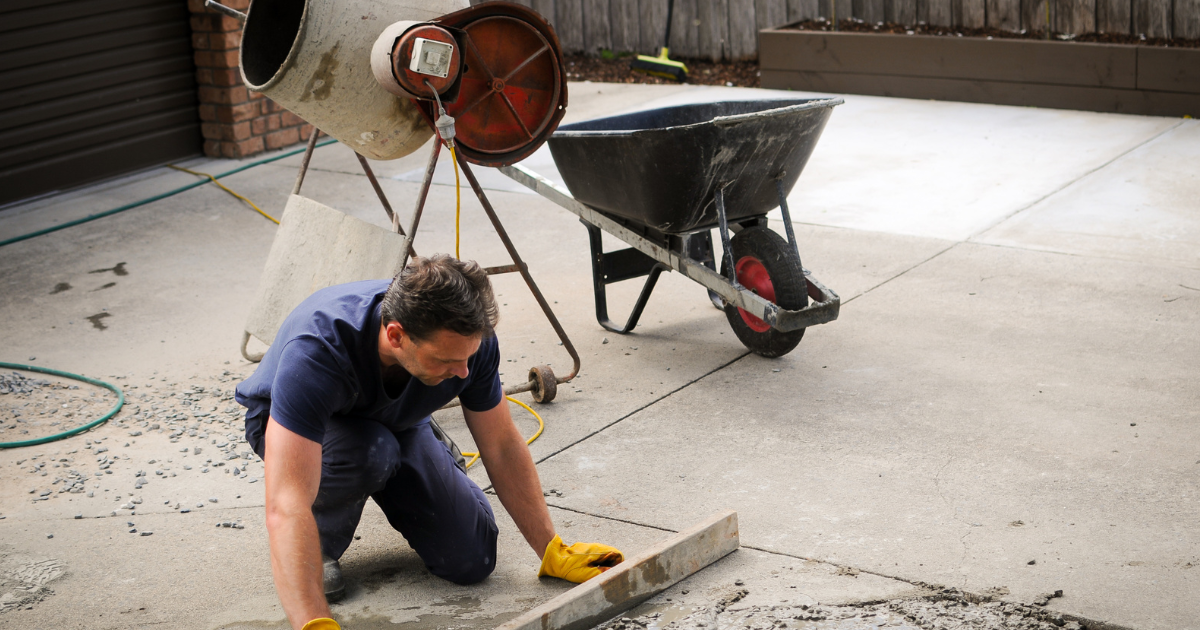 Replacing a driveway apron often requires a ROW permit.
How to get a right of way permit
Here’s a brief rundown of how to get a ROW permit. The order here matters more than it does on most permits. The first two steps can change your route design, which means getting them wrong costs you rework rather than just a longer wait. Work through the sequence before you draw anything:
- Identify the road owner. Confirm whether the street is city, county, or state maintained before you apply anywhere. Getting this wrong costs a full review cycle.
- Check for a pavement moratorium. Most agencies prohibit cutting streets paved within the last three to five years, or charge a substantial penalty fee. Check before you design the route.
- Register as a ROW contractor if required. Many agencies maintain a separate registration with its own insurance and bonding requirements, and it must be current before a permit will issue.
- Prepare the traffic control plan. Use the agency's standard details wherever one applies. Custom plans get more scrutiny.
- File the 811 locate request. Utility locates are required and have their own lead time, typically two to three business days.
- Submit and pay. Fees commonly combine an application fee, a per-square-foot pavement cut fee, an inspection fee, and a restoration deposit.
- Coordinate with your building permit schedule. ROW review often runs longer than building permit review, so it should be filed early rather than treated as a late-stage detail.
- Complete restoration and close the permit. Restoration is inspected separately, and bond release depends on it. Expect a warranty period, often one year, on the restored pavement.
Common Problems with Right of Way Permits
Most ROW permit delays trace back to a short list of predictable mistakes. Nearly all of them are cheaper to avoid during design than to fix once an application has been returned. These are the ones that come up most often:
- Applying to the wrong agency. State highways inside city limits are the classic case.
- Discovering a pavement moratorium after design. Rerouting late is expensive. Check first.
- Traffic control plan rejection. The most common cause of delay, and usually avoidable by using standard details.
- Treating ROW as a subtask of the building permit. Different agency, different queue, often a longer one. Projects stall here.
- Underestimating restoration standards. Agencies frequently require a larger patch than the cut, sometimes full-lane-width grind and overlay.
- Missing seasonal restrictions. Cold-weather paving limits close the window in northern jurisdictions for months.
Because ROW work often runs alongside a larger development, it also interacts with the land entitlement process. On projects with significant public improvements, a contractor may bring in a permit expediter specifically to manage the public works track in parallel with the building track.
ROW permits are the earliest visible signal of fiber, utility, and infrastructure buildout, but they sit in thousands of separate public works systems. Shovels brings them into one searchable dataset, so you can follow right-of-way activity across markets. Explore ROW permits with Shovels Online, or contact us to talk through coverage for a specific market or corridor.
Frequently Asked Questions
- What is the difference between a right of way permit and an encroachment permit?
-
They usually describe the same thing. California and several other states use "encroachment permit" for any work or structure placed within the public right of way, while most jurisdictions say "right of way permit." A few agencies distinguish them, using encroachment permit for permanent installations and ROW permit for temporary work.
- How do I get a right of way permit in Austin?
-
Austin issues right-of-way permits through the Right-of-Way Management division of Austin Transportation and Public Works, with applications submitted online through the Austin Build + Connect portal. Permits for excavation, driveways and sidewalks, dumpsters, temporary right of way use, and sidewalk cafés require insurance, a $10,000 bond, and a ROW Contractor License. Most work also needs an approved Traffic Control Plan. Austin is a useful reference point, but every city sets its own requirements.
- Do I need to coordinate right of way work with other projects?
-
In some cities, yes. Austin runs a Utility Location and Coordination Committee that meets to identify right of way utility conflicts before construction begins, and work inside its Downtown Project Coordination Zone must be coordinated with other active projects first. Larger jurisdictions increasingly require this kind of coordination, which adds lead time you should plan for.
- Do I need a right of way permit to replace my driveway?
-
Usually yes, for the portion between the sidewalk and the street. That section, the driveway approach or apron, sits in the public right of way even though the driveway is on your property. The portion on your lot is typically covered by a building permit instead.
- How long does a right of way permit take?
-
Simple applications with a standard traffic control plan are often approved in a few business days to two weeks. Work requiring lane closures, boring under a state highway, or railroad coordination can take one to three months. State DOT review generally runs longer than city review.
- How much does a right of way permit cost?
-
Fees are typically layered: an application fee, a pavement cut fee based on area, an inspection fee, and a refundable restoration bond or deposit. Small residential work may total a few hundred dollars. A utility trenching project across multiple blocks can run into thousands, plus a bond sized to restoration cost.
- Who owns the sidewalk in front of my house?
-
In most jurisdictions the public agency owns the sidewalk as part of the right of way, while the adjacent property owner is responsible for maintaining it and often liable for its condition. That split is why sidewalk repair can be your obligation on land you do not own.
- Can I get a right of way permit as a homeowner?
-
For minor work such as landscaping in the parkway, often yes. For anything involving pavement cutting, excavation, or traffic control, most agencies require a licensed and ROW-registered contractor because of the bonding and insurance requirements.
- What is a pavement moratorium?
-
A restriction preventing street cuts on recently resurfaced pavement, commonly for three to five years after paving. Agencies impose them because cutting new pavement shortens its life. Some allow cuts with a substantial penalty fee, others prohibit them outright, which can force a project to bore under the street instead.
- How can I see right of way permit activity in a city?
-
ROW permits are public records, so you can always request them from the public works department that issued them, one agency at a time. That works for a single project, but not for monitoring fiber or utility buildout across a region. To see ROW activity in many jurisdictions at once, you need aggregated data: Shovels collects permit records from public works systems nationwide and makes them searchable by permit type, including right-of-way and encroachment permits.