


Property ownership is public record in nearly every US county. Usually, the fastest route to it is the county assessor's property search. Enter the address or parcel number and you will usually get the owner of record and their mailing address at no cost.
That answers most questions in about two minutes. This guide covers what to do when it does not: vacant land with no address, an LLC on the deed, and records that are simply out of date.
How to Find Out Who Owns a Property
The general process is the same in most of the country.
- Identify the parcel. If you have a street address, use it to look up the assessor parcel number. County systems index records by APN, which removes the ambiguity that addresses can introduce near jurisdictional boundaries.
- Search the county assessor's property records. Nearly every county publishes a searchable property or parcel database. Search by address, APN, or owner name. The record typically shows the owner of record, a mailing address, assessed value, and basic building characteristics.
- Confirm against the recorder's office. The assessor tells you who is being taxed. The recorder, register of deeds, or county clerk holds the recorded deeds that establish who legally owns it. For anything consequential, verify against the deed.
- Note the deed type and date. The most recent recorded deed names the current owner. The type matters: a warranty deed suggests an arm's-length sale, while a quitclaim often signals a transfer between related parties or into a trust.
- Handle an entity owner. If the owner is an LLC, corporation, or trust, the name on the deed is where the search begins rather than ends. See below.
For a single property, this method is probably enough. When you're searching addresses at scale, however, looking at unaddressed land, or trying to determine whether an address changed hands recently, you'll likely need a more robust solution.
Where Property Ownership Records Actually Live
Four different county sources hold overlapping pieces of this information, and confusing them is the most common reason people conclude that the record does not exist.
The assessor maintains the tax roll: who owns each parcel for assessment purposes, the mailing address for the tax bill, assessed value, and building characteristics. This is the most accessible source and the one most online property search tools are built on. It is derived data, updated on the county's assessment cycle.
The recorder, register of deeds, or county clerk maintains recorded documents: deeds, mortgages, liens, easements, and releases. This is the authoritative ownership record and the legal chain of title. Many counties have digitized recent records and left older ones on microfilm or paper.
The treasurer or tax collector shows who actually pays the tax bill. Often, this is not the owner. A mortgage servicer paying from escrow will appear here, which is why this office is the wrong place to establish ownership.
The GIS or parcel viewer is a mapping application that renders parcel boundaries and usually surfaces the assessor's owner field when you click a parcel. It is the easiest interface and the best starting point when you do not have an address, because you can navigate visually.
If your county's records are thin or offline, that is not unusual. Digitization varies enormously, and rural counties routinely require a phone call or an in-person visit to the courthouse.
How to See Who Owns a Property Online for Free
You can almost always do this without paying a fee. Here are the free routes:
- The county assessor's property search. The most direct source for owner of record, available in most counties.
- The county GIS or parcel viewer. Visual, and the right tool when you have a location but not an address.
- The recorder's online document search. Free to search in many counties, though copies of documents often carry a per-page fee.
- State-level parcel viewers. Some states aggregate county parcel data into a single statewide map, which saves you identifying the county first.
- A commercial resource like Shovels Online. Free to sign up and search any address nationwide. Every property record is standardized, geocoded, and resolved to its parcel number, then tied to the property's full permit history. That gets you the APN and the work done at the address in one step, and permits carry the owner name as filed with the jurisdiction.
Judge any source by two things: whether it tells you where and when each field came from, and whether it gives you something the county does not.
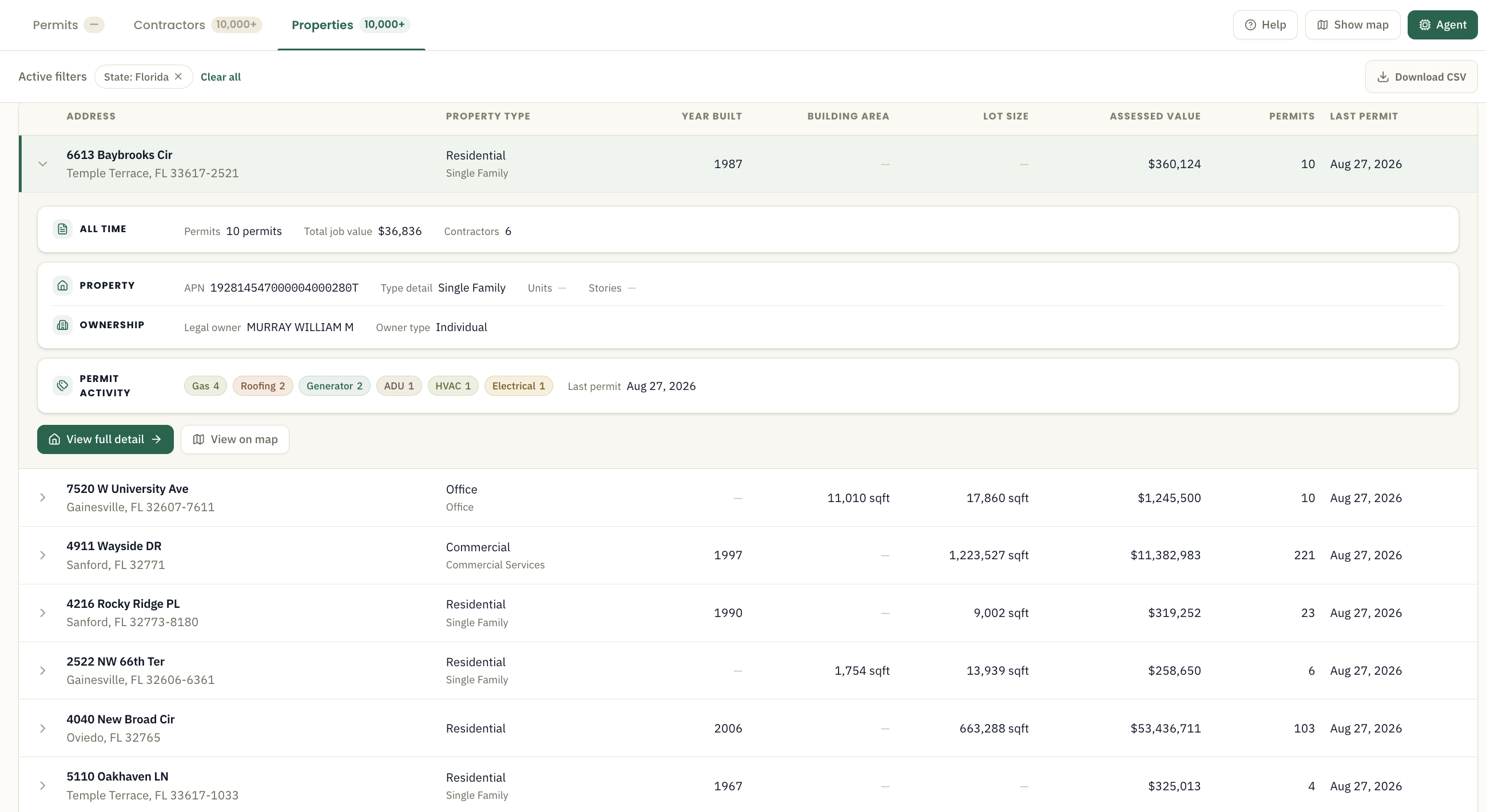
Looking for an address? You can look up a property and attached permits for free on Shovels Online.
One legitimate caution about free sources: owner information is public, but a handful of categories are restricted. Most states operate address confidentiality programs that allow judges, law enforcement officers, and survivors of domestic violence or stalking to have their identifying information withheld from public property records. A parcel that shows no owner name is sometimes protected rather than missing.
How to Find Out Who Owns Land
If you are trying to answer who owns the land your house is on, and you own the house, the answer is normally you. The exception is a land lease arrangement, common in some resort areas, manufactured housing communities, and on certain tribal and public lands, where the structure and the land underneath it have different owners. Your deed and title policy will say so.
Looking up vacant land can be trickier. The shortcuts that work on houses do not apply to land alone since there is usually no street address, no building, and no listing.
If you're looking for land ownership records, work from the location to the parcel identifier instead:
- Locate the parcel on the county GIS viewer. Navigate to the location on the map and click it. This is the step that replaces the address search, and it is why the GIS viewer matters more for land than for improved property.
- Read the parcel number off the map. Once the parcel is selected, the viewer gives you the APN and usually the owner name directly.
- Get the legal description. Rural land is frequently described by metes and bounds or by the Public Land Survey System, using township, range, and section rather than a lot number. The recorder indexes older documents this way, so you will need it for anything historic.
- Check adjacent parcels. Large holdings are often split across several parcels under the same or related owners. Looking only at the one parcel can misrepresent who controls the land around it.
- Search the recorder by owner name. Once you have a name, searching the grantor and grantee indexes reveals the full set of holdings in that county, which is the practical way to understand an assembly.
There are some land-specific complications worth knowing. Mineral rights and surface rights can be severed. This means the surface owner and the mineral owner may be different parties, with their rights recorded in separate documents. Access is also a separate question from ownership. A landlocked parcel may depend on an easement across a neighbor, which is recorded but easy to miss.
When the Owner Is an LLC or a Trust
This is where most searches stall, and it is increasingly common with both investment properties and high-value homes.
For an LLC or corporation, search the business entity database maintained by the Secretary of State in the entity's state of formation. The filing will typically include:
- The registered agent and address used for service of process
- The principal office address
- The entity's formation date and current status
- In some states, the names of members, managers, or officers
The complication is that disclosure requirements vary. Delaware, Nevada, and Wyoming, for example, generally do not require members to be identified in public filings. An entity formed in one of these states but holding property elsewhere may only list its registered agent.
When the public record ends there, other useful sources include the registered agent, the signature block on the recorded deed (which may identify the person authorized to sign for the entity), and permit filings, which often name the individual or operating company overseeing the work.

Federal beneficial ownership reporting rules have also changed repeatedly because of regulatory and court action. If ownership information is important to your situation, verify the current requirements directly rather than relying on a summary.
For a trust, expect even less. Trusts generally are not registered with a public agency. The deed will usually identify the trust and its trustee, making the trustee the most likely point of contact. Beneficiaries typically remain private, with no public filing that identifies them.
Why Ownership Records Are Sometimes Wrong
Assuming the assessor record is up to date is a common mistake in property research. Here are some reasons why it might not be:
- Recording lag. A deed is recorded days to weeks after closing, and the assessor roll may only refresh on an annual cycle. A property sold last month can still show the prior owner.
- Mailing address versus owner. The assessor's mailing address is where the tax bill goes. For rentals, entity-owned property, and property in escrow, it is not where the owner lives.
- Deceased owners. Property held through probate can sit in a deceased owner's name for a long time before the estate transfers it.
- Unrecorded transfers. Contracts for deed, land contracts, and some transfer-on-death arrangements can leave the recorded owner different from the party with beneficial interest.
- Name variations and data entry. The same person appears as different owners across records through middle initials, married names, and transcription errors.
- Split and merged parcels. When parcels are divided or combined, new APNs are issued and the history attaches to retired numbers, which can make a property look like it has no record.
Roughly a dozen states are also considered non-disclosure states, meaning property sale prices are not public record. The restriction applies to the sale price, not ownership. Property owners' names generally remain public.
How to Verify Ownership and Fill in the Gaps
When money is at stake, no single source is enough. Use this verification sequence:
- Cross-check the assessor record against the recorder's office. If the owner listed by the assessor differs from the grantee on the most recent deed, rely on the deed. The assessor's record is likely outdated.
- Read the deed itself, not just the index entry. The full document identifies the grantor, grantee, deed type, recording date, and, when an entity is involved, the individual authorized to sign on its behalf.
- Review the permit history. Dated filings from owners and contractors can corroborate the ownership timeline, show what has been done to the property, and identify a person when the deed lists only an entity. They can also surface unpermitted work, which matters when evaluating the property, not just identifying its owner.
- Confirm the parcel boundary. Check the parcel map to make sure the record corresponds to the land in question, especially if the property has been subdivided.
- Order a title search before a transaction. Public-record research is useful for screening, but it does not protect a purchase. A title search and title insurance address liens, encumbrances, and other issues that a simple owner-name search may miss.
- Call the county. Assessor and recorder staff can clarify their own records. In unusual cases, a phone call is often faster than searching through multiple databases.
At portfolio scale, the challenge changes. Verifying one property across two county offices is manageable. Verifying a thousand properties across two hundred counties, each with its own portal, format, and update cycle, is no longer a research task. It is a data problem, and that is where aggregated sources become valuable.
Frequently Asked Questions
- How can I find out who owns a property?
-
Search your county assessor's online property records by address or parcel number. That is free and returns the owner of record plus a mailing address in most counties. For legal certainty, verify against the most recent recorded deed at the county recorder or register of deeds, since the assessor's data is derived from those records and updates on a slower cycle.
- How do I find out who owns a house?
-
Start with the county assessor's property search, then confirm the result using the recorder's deed records. Because houses have street addresses, the address search usually works directly. If the record names an LLC or a trust, look the entity up in the Secretary of State business filings for the state where it was formed.
- How do I find property owner information by address for free?
-
Start with the county assessor's property search and the county GIS parcel viewer, which are free in most counties and are authoritative sources for the owner of record. Recorder document searches are usually free to search as well, though document copies often carry a per-page fee. Shovels Online is also free to sign up for and resolves any US address to its parcel number with the property's full permit history attached, which helps when a county portal is offline or you are checking properties across several counties.
- Where can I find out who owns a property if my county has no online search?
-
Call or visit the assessor and recorder offices directly. Records remain public whether or not they are digitized, and staff can search them for you. Some counties charge a small research or copy fee. Rural counties are the most likely to require this, and older records in every county are often still on microfilm or paper.
- How do I find out who owns land with no address?
-
Locate the parcel on the county GIS viewer by navigating to it on the map, then click it to get the parcel number and usually the owner name. For rural land, you may also need the legal description, expressed as metes and bounds or as Public Land Survey System township, range, and section, since that is how older recorded documents are indexed.
- How do I find the owner of a property owned by an LLC?
-
Search the Secretary of State business entity database in the LLC's state of formation. You will generally get a registered agent, a principal address, and in many states the members or managers. Delaware, Nevada, and Wyoming do not require public member disclosure, so those filings may show only an agent. The signature block on the recorded deed and any building permits filed on the property are the practical alternatives.
- Who owns the land my house is on?
-
If you hold fee simple title, you own both the house and the land beneath it, and your deed will say so. In a land lease arrangement, which occurs in some resort communities, manufactured housing parks, and on certain tribal and public lands, a separate party owns the land and you lease it. Your title policy and deed identify which applies.
- How do I check who the current owner of a property is if it was recently sold?
-
Go to the recorder rather than the assessor. A new deed is recorded within days to weeks of closing, while assessor rolls in many counties refresh only annually. A recent sale will appear in the recorded documents well before the tax roll reflects it. Recent permit filings can also name a new owner early.
- Is property ownership always public record?
-
Almost always. Ownership is recorded so title can be established and taxed, which makes it public by design. The exceptions are narrow: most states run address confidentiality programs for judges, law enforcement, and survivors of domestic violence or stalking. Separately, about a dozen non-disclosure states withhold sale prices, but that restricts price rather than ownership.