


In December 2025, Texas received the largest BEAD allocation in the country: $3.3 billion to expand broadband access to underserved homes and businesses. As construction begins in 2026, providers will spend the next several years extending fiber networks across hundreds of counties.
But funding maps tell only part of the story. They show where public dollars are going, not where construction is already underway or where demand is growing fastest.
To see the full picture, we combined Texas building permit data, Shovels Decisions data, BEAD award data, and population trends. The result shows where providers are already building, where public investment is accelerating deployment, and where growing communities are creating real broadband demand. In the markets where new fiber and new households arrive together, providers have an opportunity to win over customers as soon as they move in.
Key Takeaways
- Biggest award in the country: Texas won the largest BEAD allocation in the country at $3.3 billion and has signed final contracts with 17 providers to connect more than 208,000 locations.
- Technology-neutral now: A 2025 program overhaul dropped the fiber-only preference, so fiber, fixed wireless, and satellite compete on cost.
- The window is now: Construction starts as early as summer 2026, with most builds running through 2030.
- Carriers are already there: Spectrum/Charter, a BEAD subgrantee, is already securing fiber right-of-way in its award counties.
- Growth is concentrated: Statewide single-family permitting cooled roughly 11% in 2025 (U.S. Census Building Permits Survey), yet specific Hill Country, I-35 corridor, and Dallas-area jurisdictions kept expanding.
- Shovels connects the dots: Permit and decision data reveal where homes and fiber are arriving in the same place, down to the address.
Methodology
All permit counts from the Shovels dataset reflect our jurisdiction coverage and should be read as relative, directional signals and not as definitive benchmarks.
- New-construction permits are filtered to active permits and grouped by permit issue date. Each count represents a distinct new-build address (deduplicated so permits for the same project are not double-counted).
- Government decisions are drawn from Shovels’ decisions data and filtered via keyword matching for broadband and fiber activity in Texas BEAD-subgrantee counties.
- “Fiber permits” refer to permits relating to new fiber or broadband infrastructure, identified via keyword matching. They are attributed to providers using each permit’s filing entity. Provider counts are conservative, and the figures exclude maintenance and repair work.
Texas won the largest BEAD award in the country
The Broadband Equity, Access, and Deployment (BEAD) program is the federal government's largest broadband infrastructure investment ever, funding new internet service in areas that private providers have historically left unserved or underserved. The program is administered by the National Telecommunications and Information Administration (NTIA).
Texas received the country's largest allocation because it has more eligible locations than any other state. After the NTIA revised the program in mid-2025, the state's final award totaled $1.26 billion.
Of the 22 awardees, two are satellite providers that require little or no local construction. SpaceX received $109 million to serve roughly 65,000 locations through Starlink, while Amazon Kuiper received $1 million. 17 of the awardees have already signed contracts, and construction is slated to begin as early as summer 2026. Most projects are expected to be completed between 2026 and 2030.
While the award list is broad, a few providers account for most of the planned fiber buildout:
| Subgrantee | Federal award | Locations | Where they'll cover |
|---|---|---|---|
| 4 IP Technology / Nexstream | $401.8M | 32,404 | Hill Country and Central Texas (Travis, Bell, Burnet, Llano, Blanco, Bexar, Medina, Kerr) |
| Astound Networks | $165M | 2,522 | Collin, Montgomery, Brazoria, Hunt, Brazos |
| Lyte Fiber | $116.0M | 9,666 | Bee, Cass, Harris, Kleberg, Marion, Navarro |
| Frontier Southwest | $59M | 1,512 | Harris, Cherokee, Galveston, Chambers, Gregg + more |
| Aristotle | $57M | 1,231 | Collin, Harrison, Upshur |
| Spectrum Gulf Coast (Charter) | $47.8M | 7,830 | Frio, Hays, Jefferson, Kaufman, Leon |
| Brightspeed | $24M | 929 | Henderson, Milam, Hays, Grimes + more |
Nexstream / 4 IP at $407 million represents roughly a third of the total federal award and a 7,044-mile buildout concentrated in the Hill Country and I-35 corridor. As we will see in the permit records, these are the same counties already laying the groundwork for construction.
The award calendar is showing up in permit counts
Providers typically start filing right-of-way permits, utility permits, and local approvals as soon as awards become likely and long before construction starts. When we looked at the permit record, we already saw traces of BEAD construction starting.
In counties included in Texas BEAD awards, quarterly fiber permitting climbed significantly through the second half of 2025 and reached 912 permits in the first quarter of 2026, one of the busiest quarters on record.
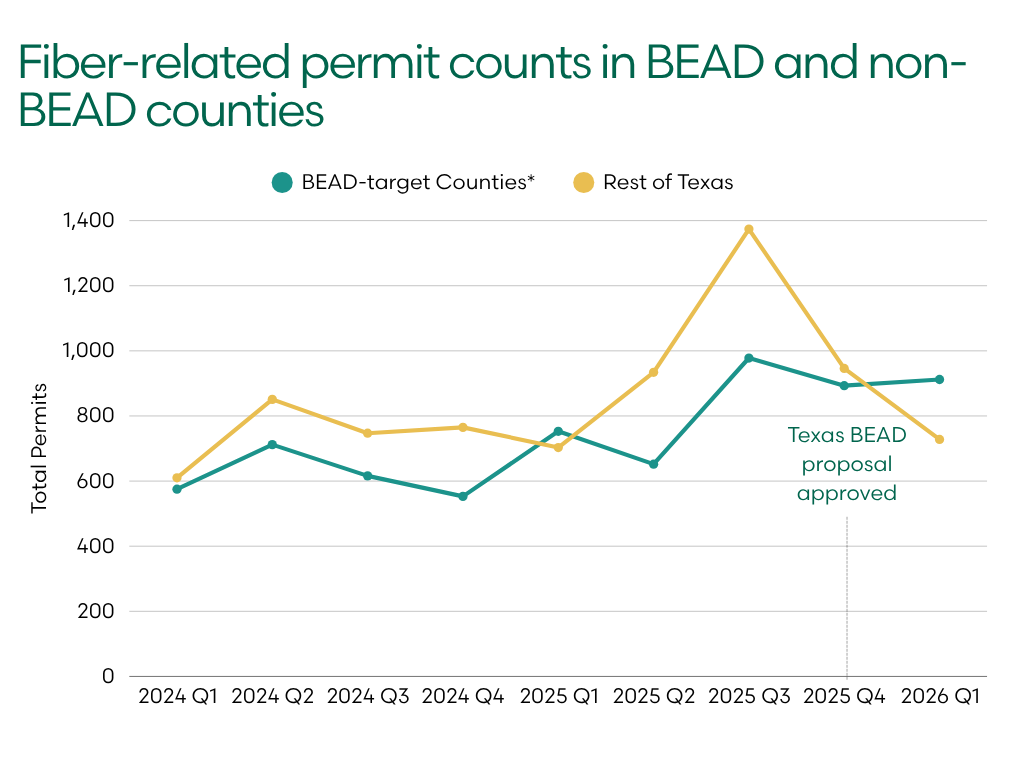
- "BEAD-target" counties are those named in Texas BEAD subgrantee awards.
| Quarter | BEAD-target Counties* | Rest of Texas |
|---|---|---|
| 2024 Q1 | 575 | 610 |
| 2024 Q2 | 712 | 851 |
| 2024 Q3 | 616 | 747 |
| 2024 Q4 | 553 | 765 |
| 2025 Q1 | 753 | 703 |
| 2025 Q2 | 652 | 934 |
| 2025 Q3 | 978 | 1,374 |
| 2025 Q4 | 893 | 946 |
| 2026 Q1 | 912 | 728 |
BEAD counties accounted for most of the state's fiber permitting activity in Q1 2026, up from less than half in early 2024. The steepest acceleration is concentrated exactly where the awards are densest, along the I-35 and Hill Country corridor.
The providers already leading the way
Since the start of 2024, multiple broadband providers have pulled fiber-construction permits across Texas. Statewide, network expansion is clearly underway. Texas issued roughly 7,080 fiber-related construction permits in 2025, about 25% more than the year before and the highest annual total in at least six years.
Much of the BEAD buildout is still ramping up, but several awardees have started pulling fiber-construction permits as part of their broader network expansions across Texas.
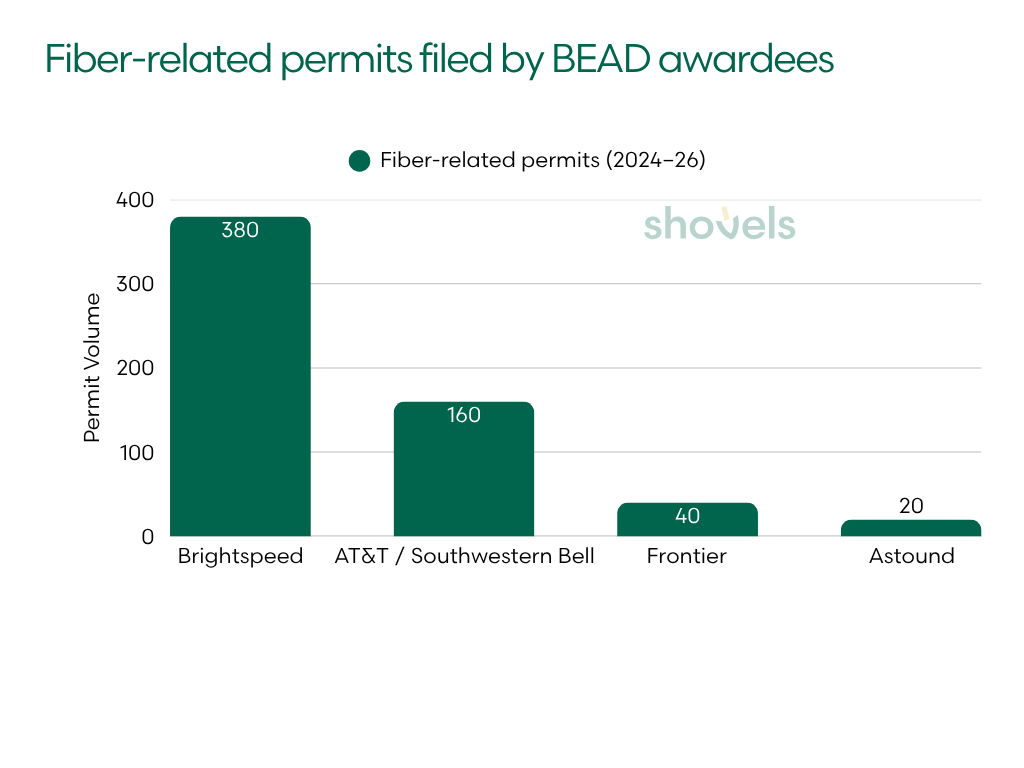
| Provider | BEAD subgrantee | Fiber permits (2024–26)* | Mostly | Primary counties |
|---|---|---|---|---|
| Brightspeed | Yes | ~380 (~170 are via contractor SQUAN, San Marcos) | New construction | Bell (Harker Heights, Killeen); Hays (San Marcos) |
| AT&T / Southwestern Bell | Yes | ~160 | New construction | Fort Bend, Brazoria |
| Frontier | Yes | ~40 | New construction | Fort Bend, Denton |
| Astound | Yes | ~20 | New construction | Brazoria, Hays |
*Provider permit totals are conservative, so we use approximations. Many permits are filed under contractor or applicant names rather than the carrier's, so actual counts may be higher.
That surge suggests the industry is moving from planning into deployment, even though many BEAD-funded projects are still in their early stages.
Brightspeed: the earliest BEAD construction signal
Among the BEAD awardees, Brightspeed stands out. Brightspeed's award area includes Nolanville in Bell County, and beginning in June 2025 the company started pulling fiber-construction permits across Harker Heights, Killeen, and surrounding communities.
In less than a year, it filed more than 200 permits, the vast majority for new route construction. That activity reshaped the county-level permit record. Bell County went from just six fiber-related construction permits in 2024 to 339 in 2025, with Brightspeed accounting for most of the increase.
Another sign of Brightspeed’s expansion is in San Marcos. Hays County is one of Brightspeed's four Texas BEAD award counties, and between January 23 and February 12, 2026, its contractor SQUAN filed roughly 170 permits across the city, nearly all naming Brightspeed and referencing systematic grid codes tied to individual neighborhoods (Southwest Hills, Oak Heights, Westover).
A representative filing describes Brightspeed placing "aerial fiber optic cable within the city ROW" and attaching new fiber to SMEU-owned utility poles. The volume and coordination point to a citywide aerial deployment beginning exactly as BEAD construction is meant to start.
AT&T: expanding an existing network
AT&T, through Southwestern Bell, has the broadest geographic footprint among BEAD awardees in the permit data, with construction permits spanning six counties since the start of 2024.
Most of that activity is concentrated in the Houston metro, particularly Fort Bend County, with newer permits appearing in Brazoria beginning in mid-2025. Nearly all involve new-route construction rather than maintenance.

Stock photo of fiber route buildout
Much of the work reflects AT&T's broader fiber expansion rather than its BEAD obligations, but it demonstrates that one of Texas's largest awardees already has an established construction pipeline in place.
Frontier: an established footprint ahead of BEAD
Frontier Southwest appears less frequently in the permit record than Brightspeed or AT&T, but it boasts a growing presence in Texas.
Since the start of 2024, Frontier has pulled fiber-construction permits primarily in Fort Bend and Denton counties, with additional activity around Austin, Bastrop, and Burnet. Most of these projects fall outside the company's East Texas and Gulf Coast BEAD territories, reflecting Frontier's broader statewide fiber expansion rather than BEAD-specific work.
That existing footprint matters. Providers already building, permitting, and managing crews in Texas can leverage those capabilities as BEAD construction ramps up. While Frontier's largest federally funded deployments are still ahead, the permit record suggests the company enters the program with active operations and experience delivering fiber projects across the state.
Spectrum is laying the groundwork
Building permits are not the only signal of activity. Spectrum Gulf Coast (Charter) appears repeatedly in the public record through right-of-way grants, infrastructure agreements, and community anchor designations that local governments approve before construction begins.
The approvals below capture different stages of the network buildout process, from securing funding and community partnerships to obtaining the right to install fiber in public rights-of-way.
| BEAD County | Date | Decision | Program |
|---|---|---|---|
| Bexar | 2023–2024 | $5.42M and $6.35M broadband agreements with Spectrum, plus a Google Fiber right-of-way license | ARPA |
| El Paso | November 2024 | $2.26M broadband-infrastructure agreement with Spectrum Gulf Coast | ARPA |
| Harris | April 2024 | County library system designated a Broadband Community Anchor Institution | BEAD (Community Anchor Institution) |
| Kaufman | December 2025 | Spectrum approved for aerial fiber installs across multiple county roads, Precinct 1 | Right-of-way grant |
| Waller | April 2026 | Charter approved for aerial and underground fiber-optic cable in county right-of-way | Right-of-way grant |
Early agreements establish anchor institutions such as libraries and schools. Later approvals give providers access to public roads and utility corridors so construction can begin. Each decision represents another step toward putting fiber in the ground.
Some of these approvals predate BEAD or were funded through ARPA and other state and local initiatives. That's typical of broadband deployment, which often spans multiple funding programs and several years of local approvals before construction ramps up.
Rather than marking a completely new starting point, BEAD is accelerating projects that were already progressing through the planning and permitting process.
Want construction signals before they appear in the permit record?
Shovels Decisions tracks rezoning approvals, denials, special use permits, and variance actions recorded at city council and planning board meetings across the US, giving you visibility into what local governments have approved and denied before any permit is filed.
Where infrastructure investment meets growing demand
For providers, knowing where fiber is being built is important, but it’s just as helpful to know where future customers are moving. New housing is one of the earliest indicators of broadband demand, revealing where providers will soon need additional capacity.
While Texas homebuilding slowed overall in 2025, a handful of jurisdictions within BEAD-funded counties continued to add homes at a strong pace. These communities represent some of the clearest overlaps between new fiber infrastructure and growing demand, creating an opportunity to connect residents soon after they move in.
Hill Country and the I-35 corridor: residential growth inside the biggest fiber footprint
According to Shovels data, the clearest growth trends actually sit inside funded BEAD fiber footprints, most of them within Nexstream's $400 million Central Texas award:
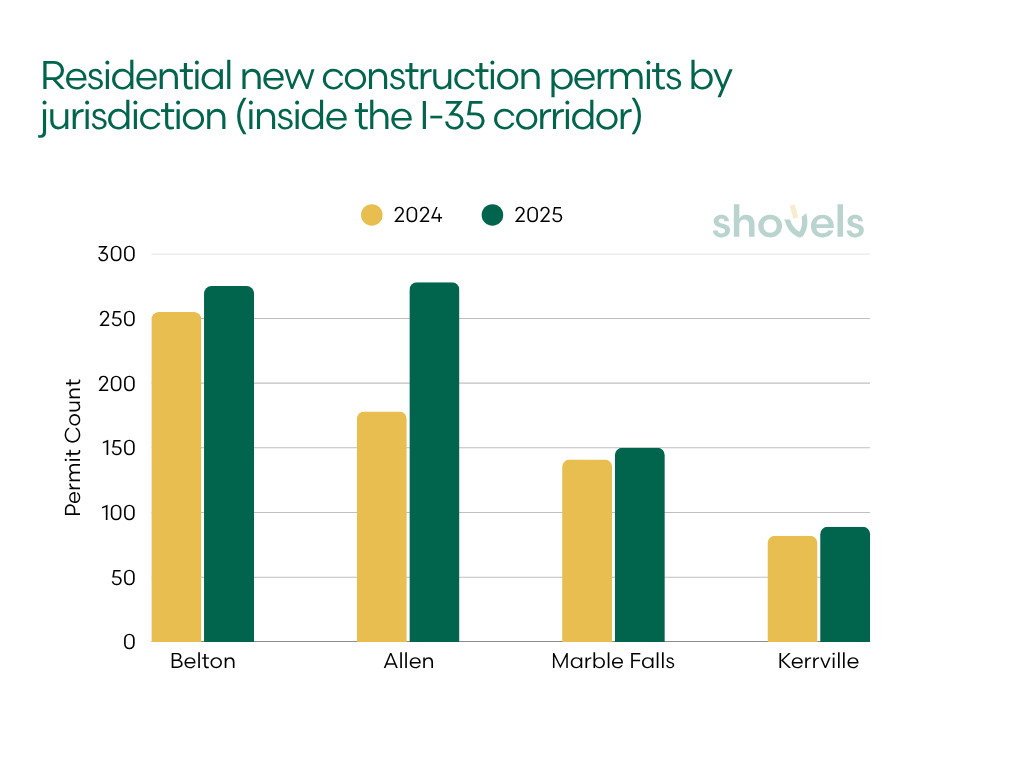
| Jurisdiction | County | BEAD provider(s) | 2024 | 2025 | YoY |
|---|---|---|---|---|---|
| Belton | Bell | Brightspeed (building); Nexstream (award) | 255 | 275 | +7.8% |
| Allen | Collin | Astound + Aristotle | 178 | 278 | +56.2% |
| Marble Falls | Burnet | Nexstream / 4 IP | 141 | 150 | +6.4% |
| Kerrville | Kerr | Nexstream / 4 IP | 82 | 89 | +8.5% |
Belton is a good example. Located along the I-35 corridor within Nexstream's Bell County award area, it has continued adding new homes each year even as statewide residential construction has slowed. Marble Falls and Kerrville tell a similar story on a smaller scale. Both sit within the same BEAD service territory and continue to add housing as fiber deployment begins.
Allen represents a different kind of opportunity. It is an established Dallas suburb with sustained residential growth rather than a traditionally underserved broadband market. Its value lies in a steadily expanding customer base, illustrating how BEAD-funded networks can intersect with some of the fastest-growing suburban communities in Texas.
The Dallas exurbs: the fastest-growing cities in the country
This brings us to Dallas. Recent U.S. Census estimates show that Texas continues to dominate national population growth, with eight of the country's 15 fastest-growing cities located in the state, most of them in the Dallas–Fort Worth exurbs.
Several of those communities sit inside or adjacent to BEAD-funded service territories. Celina, in Collin County, was the nation's fastest-growing city in 2025 after adding nearly 25% more residents in a single year, while nearby Princeton, Melissa, and Anna have all posted double-digit population growth in recent years. Fulshear, west of Houston, has followed a similar trajectory.
Population growth in Texas is increasingly concentrated in a handful of fast-growing suburban and exurban corridors rather than evenly distributed across the state. Some of those same corridors fall squarely within BEAD award areas, creating an overlap between new broadband investment and rapidly expanding housing demand.
Conclusion: following the next broadband markets
BEAD award maps show where broadband funding has been allocated. Combined with local government decisions and building permit data, they show how that funding turns into infrastructure and where that infrastructure is likely to find its next customers.
The biggest opportunities in Texas broadband won't necessarily emerge where the largest grants were awarded. They'll emerge where infrastructure deployment and housing growth reinforce one another.
That's why the public record matters. Long before a neighborhood is connected, providers appear in county agendas, right-of-way approvals, and construction permits. Before new residents look for their next provider, builders are pulling permits for the homes they’ll live in. By combining funding data with local approvals and permit records, we can identify the markets where tomorrow's demand is already under construction.
Sizing a market or planning a network? Shovels combines building permit data with local government decisions to help you identify growth, projects, and opportunities. Talk to us directly about a custom solution.
Frequently Asked Questions
- What is the BEAD program?
-
BEAD (Broadband Equity, Access, and Deployment) is a $42.45 billion federal grant program that funds internet infrastructure to reach unserved and underserved homes and businesses. It is administered by the NTIA and distributed through states.
- How much BEAD funding did Texas receive?
-
Texas was allocated $3.3 billion, the largest BEAD allocation of any state. After the 2025 rebid and final contracting, the state signed grant agreements with 17 providers committing about $1.07 billion in federal funds to connect more than 208,000 locations.
- When does BEAD construction start in Texas?
-
Texas grant agreements are expected to be finalized in early 2026, and construction can begin as early as summer 2026. Most BEAD-funded builds nationally will take place between 2026 and 2030.
- Which providers won Texas BEAD awards?
-
Seventeen providers signed final BEAD contracts. The largest awards went to 4 IP Technology / Nexstream ($401.8M, Hill Country), Lyte Fiber, Plains Internet, and Frontier Southwest, with Spectrum/Charter and Aristotle also funded. SpaceX/Starlink received the satellite award.
- Is BEAD only for fiber?
-
No. A 2025 program overhaul made BEAD technology-neutral. Fiber, fixed wireless, and low-Earth-orbit satellite can all qualify if they meet 100/20 Mbps speeds, latency under 100 ms, and scalability requirements. Fiber still accounts for most of the planned buildout, but it isn't the whole picture. Shovels' telecom permit category captures the broader footprint, including conduit, trenching, small cells, cable, and right-of-way work, so you can track the full range of infrastructure BEAD dollars support rather than fiber alone.
- Which Texas cities are growing the fastest?
-
Census Bureau estimates place eight of the nation's fifteen fastest-growing cities in Texas, led by Celina, Princeton, Melissa, and Anna north of Dallas and Fulshear west of Houston. Several of these sit inside BEAD-awardee counties.
- Why does new construction matter for BEAD?
-
BEAD funds connect locations, and new homes in funded areas are locations that will need service. Jurisdictions with growing new construction inside a BEAD footprint represent immediate demand for network expansion.