


This article was originally published on ReZone, now part of Shovels. ReZone AI tracks all City Council and Planning Department meetings nationwide.
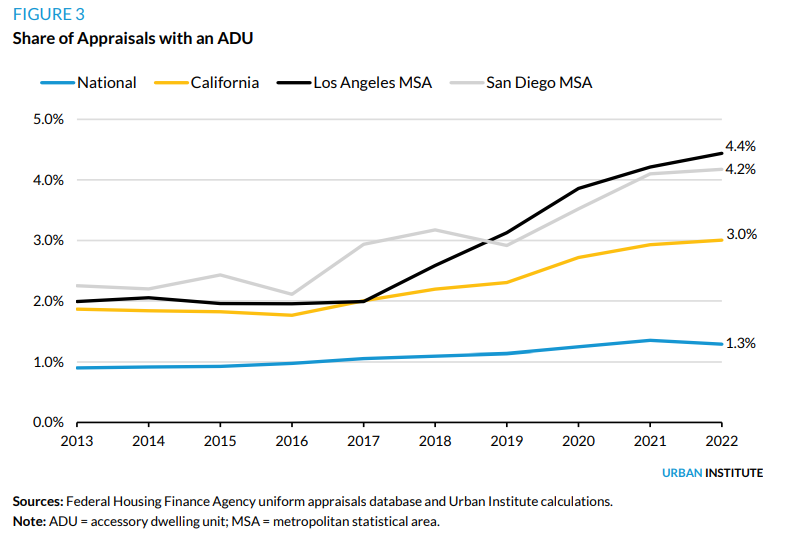
Accessory Dwelling Units (ADUs) continue to be one of the most discussed topics in Real Estate. Over the past 10 years, their popularity increased six-fold.

ADUs are seen as one of a few potential solutions to the national housing shortfall, which is the driving factor behind the current housing affordability crisis.
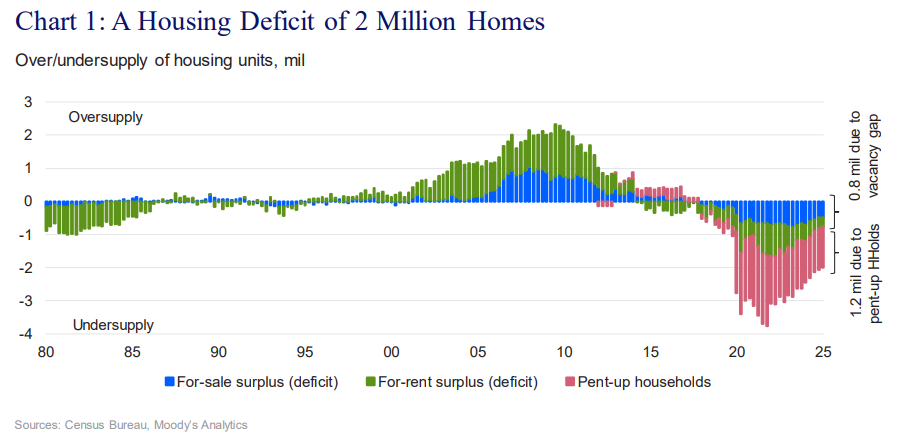
Estimates range from a housing deficit of 2M (Moody's) to the more commonly referred 3.7M (Freddie Mac).
Laurie Goodman, with the Urban Institute, estimates that if California's ADU playbook would become the nationwide playbook, then 1.1M - 1.5M additional units could be created. This is based on Appraisals data.
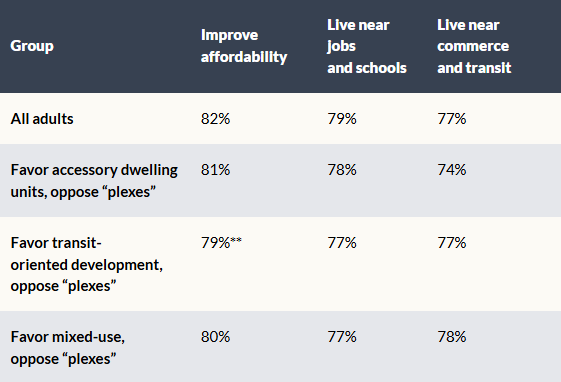
Whether ADUs will solve the housing shortage is yet to be seen, however, it is clear that people like them.
As with everything in Real Estate, the most impactful decisions happen on a local level. Municipalities have a firm grip on local land use.
ReZone (acquired by Shovels) tracks all City Council and Planning Department meetings nationwide and in this article, we will explore the past year of ADU legislation in the largest 250 cities. We will:
- Showcase city-level insights and trends
- Dive deep into new legislation changes in Colorado, Arizona, California, and Texas
- Provide you a quick history lesson on ADUs, and
- Give you full access to our dataset for further research
Nationwide Insights
The sentiment in City Council meetings towards ADUs is overwhelmingly positive. In cities that actively discuss ADUs, we observe three main types:
Tier 1 (Emerging & Discretionary): ADUs are gaining acceptance, but are still largely approved by a case-by-case process through variances and special use permits. Typically, these cities are in the Midwest or East Coast. For Developers, the opportunity lies in being nimble, locally-savvy and anticipating the transition to Tier 2.
Tier 2 (Mature & Permissive): Cities that have already undergone comprehensive, citywide reform, resulting in highly permissive, by-right regulatory frameworks. Typically, these cities are in CA, AZ, CO, and all other states with statewide ADU reforms. For Developers, the opportunity lies in scaling, financing, and efficiency.
Tier 3 (Contested & Evolving): Cities where the ADU policy framework is in flux due to political backlash or competing policy priorities. These markets present the highest degree of regulatory risk. The cities in this category seem to have no geographical relation. For Developers, the opportunity lies in having a long-time horizon and engaging in the policy-making process.
Tier 3 is an interesting case. Typically, it represents cities that have to comply with state reform, but want to hold on to their local power. Often, they introduce "poison-pill regulations" that make ADU development difficult to impossible in the spirit of preserving neighborhood character.
Other times, there are cases like San Diego, CA where ADUs have been promoted heavily and residents now feel the effects of increased densities and slowly push back.
 Multiple ADUs increase the density in this neighborhood. But at what cost?
For cities that are new to ADUs, we've found that frequent "manual" approvals of individual projects is a good indicator for a transition from Tier 1 to Tier 2.
Typically, this transition follows a similar playbook. An "ADU Reform Package" is introduced that contains some or all of these core components:
- Elimination of Parking Requirements: Cities will require no additional off-street parking for new ADUs.
- Reduced Setbacks: A new standard is emerging where cities automatically reduce side and rear yard setbacks to as little as 4ft.
- Streamlined Permitting: Conditional use permits and variances are being approved by by-right, administrative reviews.
- Owner-Occupancy Requirements: Not requiring the property-owner to reside in the primary home or ADU. Thus, making it possible to use primary home + ADU as a rental property.
- Increase Unit Allowance: Increasing the traditional limit of one ADU per SFR lot to two or even four ADUs, attached or detached, per lot.
- HOA prohibitions: Sometimes, states will void HOA covenants & restrictions. This is significant preemption of contract law.
Definition of administrative review: Applications can only be reviewed by city staff based on "objective standards" found in the zoning code. This excludes public hearings.
Trends
Trend 1: ADU Legislation as "Gateway Reform"
Increasing housing supply and density in a city is usually met with a lot of opposition.
However, people like ADUs and according to Hamilton & Houseal:
"[...] ADUs may be the lowest-hanging fruit politically." — Emily Hamilton, Senior Research Fellow, Mercatus Center
While very difficult to prove empirically, we witness time and time again that cities that introduce ADU legislation are more likely to adopt more intense uses later on.
Thus, ADU regulation can act as a "gateway reform" that introduces increased density to a city.
Trend 2: ADUs and Short-Term Rental Legislation
Naturally, the introduction of ADUs doesn't come without its consequences. One of the most common second-order consequences is the immediate emergence of ADU Short-Term Rental (STR) units.
 According to Denverite, 16% of ADUs in Denver have been used as STR in 2022.
Given that STR are said to make housing less affordable, this undercuts one of the central promises of ADUs as an affordability measure.
The linkage between ADU and STR policy has significant implications for ADU development. Particularly, because one of the most common responses to combat this "problem" is through owner-occupancy requirements.
Owner-occupancy requirements can limit the usage and economic potential of ADUs. This artificial cap on the earnings potential of ADUs decreases their development significantly.
Trend 3: State vs. City — Balancing Statewide Mandates and Local Control
State governments and cities have engaged in a dynamic interplay over ADU regulation. Traditionally, zoning was the domain of local governments, leading to a patchwork of ADU rules. In recent years, however, states have increasingly used preemption to override local zoning and ensure ADUs are broadly permitted.
In our analysis, we saw that:
- California Cities: From Santa Ana to Corona and San Diego, ordinances now reflect state mandates (such as SB 1211 and AB 2533) by eliminating restrictive parking requirements, expanding allowable ADU sizes, and legalizing previously unpermitted units.
- Arizona Cities: Decisions in Phoenix, Tucson, Chandler, and Scottsdale illustrate efforts to update setback, density, and design provisions in line with HB 2720 and related state guidelines.
Historical Overview of ADU Regulation in the U.S.
Accessory Dwelling Units (ADUs) – often called granny flats, in-law suites, or backyard cottages – have evolved from niche housing to a mainstream development strategy amid housing shortages.
Early ADU policies were largely restrictive. In the mid-20th century, single-family zoning dominated U.S. cities, effectively outlawing secondary units on residential lots.
California was a notable early mover: in 1982 the state enacted a law preventing localities from outright banning ADUs on single-family lots. However, cities found workarounds, imposing onerous permits and design standards that kept ADU approvals low.
A 2002 California law (AB 1866) tried to fix this by requiring ministerial (by-right) approval for ADUs, bypassing discretionary reviews. Still, many local governments layered on conditions that made ADU construction impractical in practice.
The modern ADU boom began in the mid-2010s, driven by state-level reforms. California's Senate Bill 1069 (in 2016) was a watershed moment, requiring cities to permit at least one ADU per single-family lot and streamlining approvals.
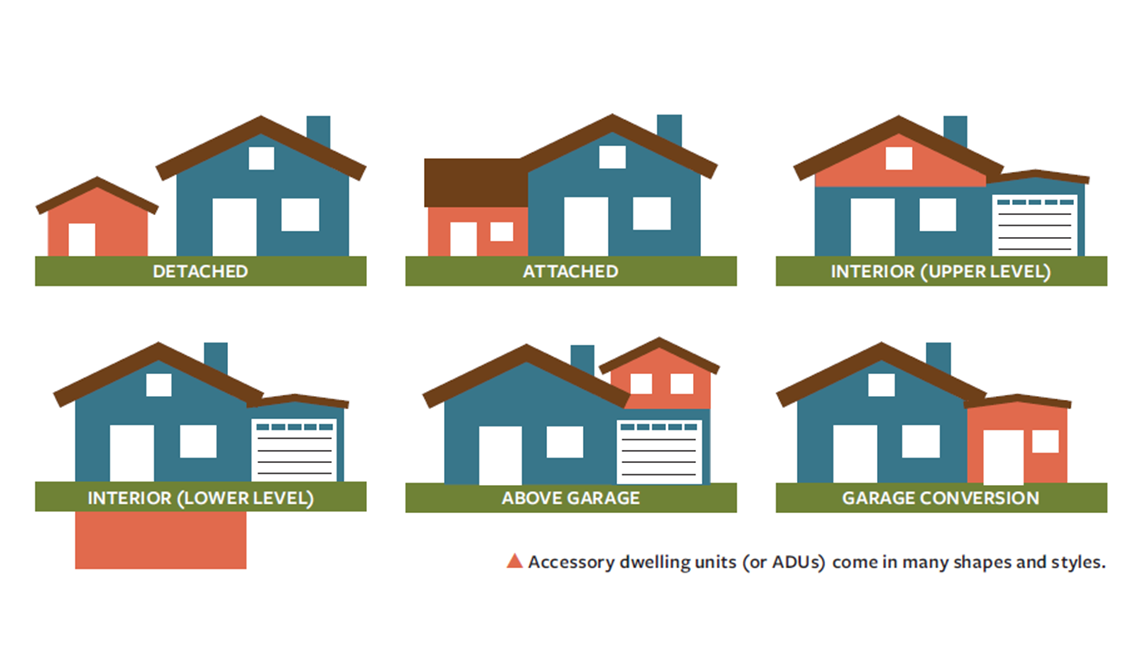 ADUs come in many shapes and styles. Source
Dataset
We've analyzed the City Council & Planning Department meetings of the largest 250+ cities in the U.S. from 6/1/24 - 9/16/25.
Our analysis includes the agendas, meeting transcripts, and minutes for each session and all decision-related documents that might've been created over the last years during the decision's path throughout the process.
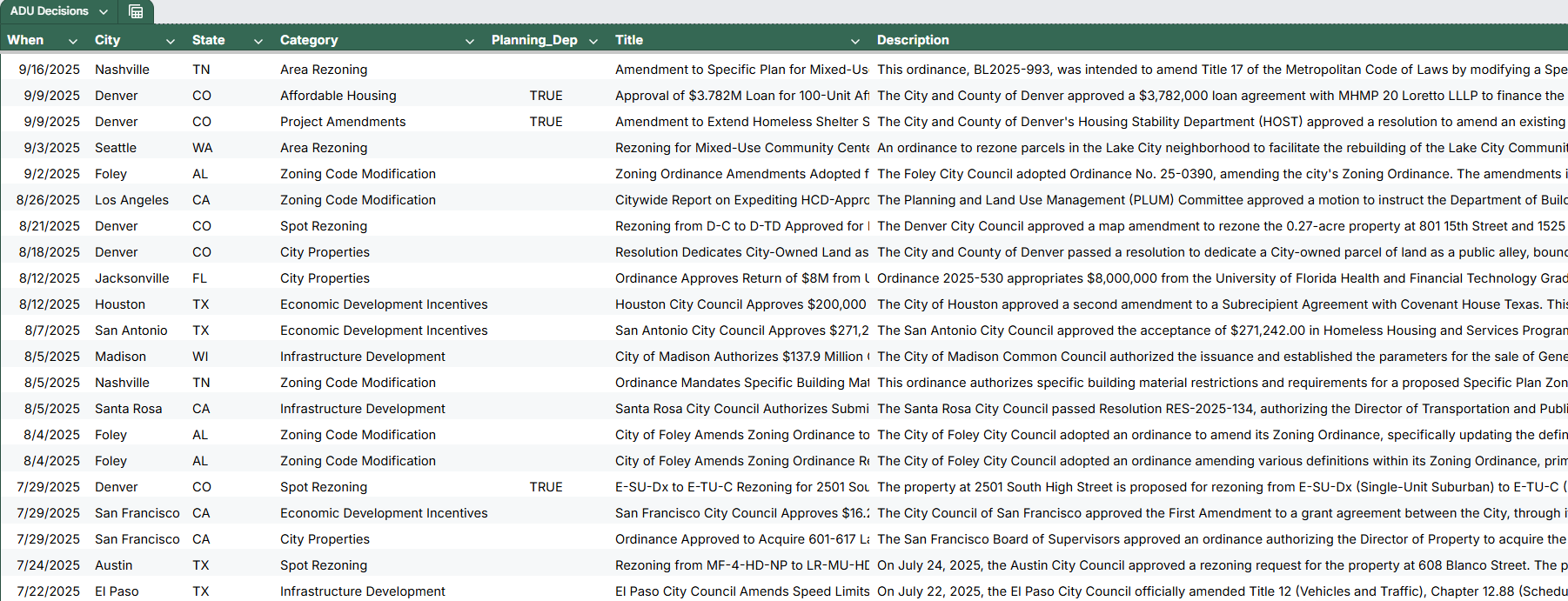
Download the data:
For questions about this research, contact the Shovels team. ReZone is now part of Shovels, bringing zoning intelligence to the Shovels platform.